

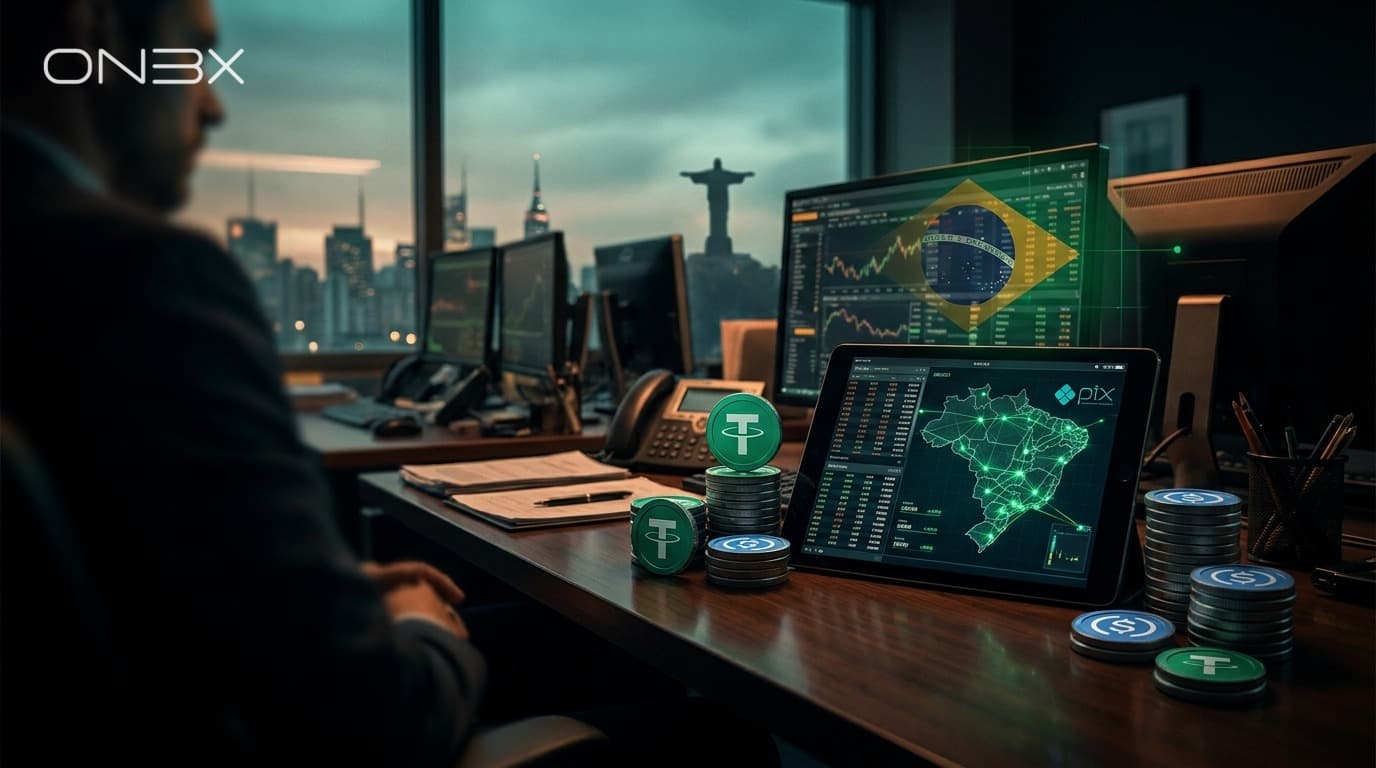
On October 1st, a lock enters into force in Brazil. BCB Resolution No. 561 prohibits electronic exchange companies (eFX) from settling international remittances using stablecoins — no longer possible to take reals from a client, convert to USDT and close the payment on-chain abroad. It's the Central Bank closing the front door for the world's largest stablecoin on regulated payment rails.
While Brasília reinforces this monetary frontier, Tether — the USDT issuer — did something else, more silent and much deeper: bought 70% of Adecoagro, one of the largest agribusiness companies in Latin America, owner of sugar and ethanol mills, rice farms, dairies and renewable energy assets in Brazil, Argentina and Uruguay. The stablecoin that the Brazilian State regulates on the surface is already, on the lower floor, owner of pieces of the country's real economy.
That's the point almost no one is looking at. The debate on monetary sovereignty in Brazil — Resolution 561, Resolution 521, Bill 4.308, the Drex saga — deals with the token: who can issue, settle and move digital money on Brazilian soil. But there's a second counter, with no regulator in sight: that of asset ownership. On it, Tether ceased to be a stablecoin fintech to become something more like a private sovereign fund — buying gold, land and infrastructure with the profits of printing digital dollars.
The two counters of the stablecoin in Brazil
It's worth separating the two layers, because they're usually confused.
The monetary layer is what the Central Bank sees and regulates. It's USDT as a means of payment and settlement. That's where the crackdown came: Resolution 561 taking USDT off the back-end of remittances, Resolution 521 putting self-custodial wallets on the forex radar, and Bill 4.308 affecting the yield and issuance of real stablecoins. All of this targets the flow: how digital money circulates within the Brazilian economy. And it makes sense to target it — according to the Federal Revenue Service, Brazil moves $6 to $8 billion per month in crypto, with stablecoins accounting for about 90% of the volume.
The patrimonial layer is what nobody regulates. It's Tether, as a company, deciding what to do with billions of dollars in quarterly profit. And the answer has been increasingly clear: buy real assets. Physical gold. Stakes in offline companies. And, in the Brazilian case, control of a giant in agribusiness and energy. This counter doesn't appear in any BCB resolution, because it's not a foreign exchange operation or a payment — it's acquisition of productive capital. And that's exactly why it goes unnoticed.
What Tether Really Bought
Adecoagro (NYSE: AGRO) is not a tokenization startup. It's a real-economy company, with market capitalization around $1 billion, operating heavy physical assets: sugar cane milling for sugar and ethanol, rice and dairy production, and energy generation — much of it renewable, from sugarcane bagasse itself. Its operations are concentrated in Brazil, Argentina and Uruguay.
Tether didn't reach 70% at once. It built the position in stages: an initial contribution of about $100 million in September 2024 for 9.8% of the company, an increase to 51% in February 2025 and, finally, consolidation of majority control at 70% already in 2026. The company framed the move as "strategic expansion in sustainable infrastructure" — vocabulary of a private equity fund, not a stablecoin issuer.
The detail that matters: today this control is exercised via traditional shareholding, not on-chain tokens. But Tether's stated thesis is precisely that of real-world assets. The logical endgame — tokenizing ethanol cash flow, grain, energy — is the frontier that Brazil debates in law while a foreign issuer is already buying the underlying asset.
The stablecoin that became a sovereign fund
To understand why Adecoagro is not a whim, you need to look at Tether's scale. The attestation from the first quarter of 2026, done by BDO, shows a balance sheet that puts mid-sized banks to shame:
- ~$141 billion in direct and indirect exposure to US Treasury securities (T-bill position larger than several nation-states);
- ~$20 billion in physical gold — 148 tonnes of bars in a vault. Jefferies estimates the stockpile above $23 billion and calculates that Tether has been buying gold faster than several central banks;
- $1.04 billion in profit just in Q1 2026, with a cushion of excess reserves at historic highs of $8.23 billion.
CEO Paolo Ardoino has already signaled the intention to take up to 15% of the company's investment portfolio to gold. Add to that the purchase of offline companies and control of Adecoagro, and the picture is obvious: Tether is on the same journey we described in the "Stablecoin Era" — only it's stock, not flow. It accumulates. And what it accumulates is not just short-term American debt; it's hard assets: metal, land, energy. A synthetic dollar issuer transforming into a transnational patrimonial conglomerate. It's no longer a fintech — it's a sovereign fund that just happens to also print stablecoins.
The link with tokenization: RWA at $34.5 billion
None of this happens in a vacuum. The market for tokenized real-world assets (RWA) hit about $34.5 billion in May 2026, more than doubling in a year. Tokenized treasuries lead, close to $15.2 billion; digital gold comes right behind; and private credit and equities are the fastest-growing segments. Standard Chartered projects the tokenized assets market at $30 trillion by 2034.
Chainalysis — partner of ON3X in blockchain analytics — was already mapping Brazilian agribusiness as one of the natural vectors for this wave, and first quarter numbers showed tokenized treasuries and digital gold leading the charge. The reading is direct: while the market discusses how to tokenize real assets, Tether solved the question by the oldest way of capitalism — buy the real asset first. Tokenizing later is just engineering detail. Sovereignty over what will be tokenized will already be defined by deed, not by smart contract.
The blind spot in sovereignty
Here's the discomfort. Brazil built, in 2026, one of the world's most aggressive regulatory architectures against digital dollars as a means of payment. Resolution 561, added to pressure on tokenized dollar remittance corridors, closes the monetary door. But the patrimonial frontier was left wide open.
The paradox is this: the world's largest private holder of Treasuries — and now one of the world's biggest buyers of gold — is becoming a landowner and industrialist in Brazil, and none of the resolutions designed to protect monetary sovereignty touches this point. A Brazilian who, starting in October, will not be able to legally settle a remittance in USDT will continue, without knowing it, buying sugar and energy from a company controlled by the issuer of that same USDT. The lock is on the wrong counter.
And there's an irony that closes the arc. Brazil tried to tokenize the real itself via Drex and gave up, outsourcing the function to B3. In other words: the State couldn't tokenize its own currency — while a foreign private issuer is already acquiring (and, ultimately, tokenizing) the real assets that back a synthetic currency. Who is actually building the tokenization infrastructure for the real, in the end, is not the Central Bank. It's whoever has $1 billion in quarterly profit to spend.
For the Brazilian market
Three practical implications. First: the backing of your USDT is changing in nature. Out goes some pure US Treasury paper, in comes gold, land and energy. This reduces dependence on US debt, but adds concentration risk — illiquid assets and operational companies don't sell at the speed of a T-bill in a redemption run.
Second: systemic concentration. A single private company, with no central bank behind it, now carries $141 billion in Treasuries, tens of billions in gold and control of agro-energy infrastructure in three South American countries. Any stress on Tether ceased to be a problem just for the crypto market — it became a real asset stability issue. For those who still treat stablecoins as "internet money," Tether's verticalization should recalibrate risk perception.
Third: the regulatory window. If sovereignty matters, it's not resolved just by barring the payment rail. While focus stays on the flow, ownership of productive stock keeps being acquired freely. It's a conversation Brazil hasn't yet started.
The ON3X perspective
Three takeaways from this move:
- Tether no longer just issues dollars — it issues balance sheets. When a stablecoin profits $1 billion per quarter and spends it on gold, land and energy, it ceases to be a payment intermediary and becomes an accumulator of capital. USDT is the retail product; the conglomerate of real assets is what's being built behind it.
- Monetary sovereignty without patrimonial sovereignty is half a wall. Brazil fortified the payment door and forgot the property door. Regulating who liquidates the token while the token issuer buys the farm is protecting the safe and leaving the house key in the lock.
- The tokenization of the real already has an owner — and it's not the State. Drex foundered, B3 inherited digital real, and the infrastructure for turning Brazilian assets into scalable tokens is being capitalized by a foreign issuer that is already the world's largest private buyer of US Treasury and gold. The question has stopped being "if" Brazilian agribusiness will be tokenized. It's "by whom".
Frequently Asked Questions
What exactly did Tether buy in Brazil?
Tether acquired 70% of Adecoagro (NYSE: AGRO), one of the largest agribusiness companies in Latin America, with sugar and ethanol mills, rice farms, dairies and renewable energy generation in Brazil, Argentina and Uruguay. The position was built in stages starting in September 2024 and consolidated in majority control in 2026.
Why is a stablecoin issuer buying farms and gold?
Tether has been migrating part of its reserves and profits from pure US Treasury securities to hard assets. In March 2026 it held about $141 billion in Treasuries, ~$20 billion in physical gold (148 tonnes) and had $1.04 billion in profit just in the quarter. Buying land, energy and metal is a diversification strategy and exposure to real-world assets (RWA).
Does this affect people holding USDT?
Indirectly, yes. The composition of backing is changing: less exclusive dependence on American debt, more real assets. This may reduce one type of risk and increase another — illiquid assets like operational companies don't liquidate as quickly as a short-term security in an eventual redemption run.
Is the Adecoagro purchase blocked by BCB Resolution 561?
No. Resolution 561 deals with settlement of international payments with stablecoins (the monetary layer), not acquisition of companies (the patrimonial layer). The purchase of shareholding in Adecoagro is a capital operation, outside the scope of the rule — which highlights the blind spot in the sovereignty regulatory design.