

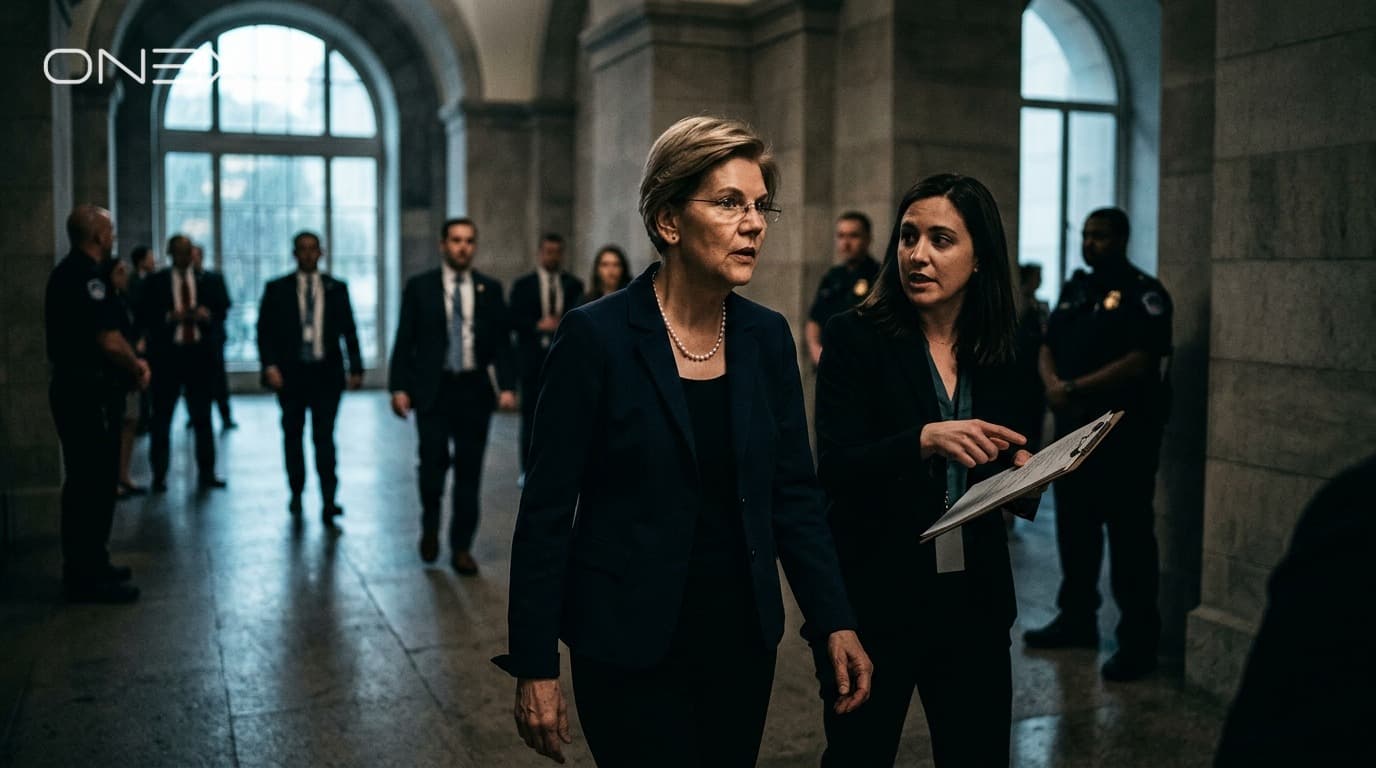
On May 14, 2026, as the Senate Banking Committee prepared for the historic markup of the CLARITY Act that would approve the bill by 15 votes to 9, the ranking member of the committee made a parallel move that few noticed. Senator Elizabeth Warren (D-MA) sent a formal letter to SEC Chairman Paul Atkins, requesting an investigation into World Liberty Financial — a cryptocurrency company controlled by the Trump family.
The target of the letter is a financial operation that the industry had increasingly been classifying openly as "FTX-style": WLFI's treasury deposited approximately US$ 440 million in its own WLFI tokens as collateral in the DeFi protocol Dolomite, and borrowed back US$ 75 million in stablecoin — specifically US$ 65.4 million in USD1 (WLFI's own stablecoin) and US$ 10.3 million in USDC. More than US$ 40 million of the proceeds were transferred to Coinbase Prime.
The detail that rewrites the entire operation: Dolomite co-founder Corey Caplan is simultaneously CTO and advisor of World Liberty Financial. The protocol from which Trump's treasury borrowed is operated by a direct insider of the borrower. In any conventional capital market, this would be sufficient conflict of interest to open a self-dealing case. In DeFi, it's just "FUD", according to WLFI's public defense.
Warren's letter arrives exactly at the crossroads. Same week that CLARITY advanced 15-9 but the Van Hollen amendment on ethics fell 11-13. Same week that ABA, BPI and ICBA attempted to reopen the yield stablecoin gap. Same week that WLFI slides to historic lows after the numbers leak.
Warren's attack is not symbolic. It is operational Plan B. The ethics amendment that lost 11-13 sought to ban the President's economic interests in digital assets during his term. It didn't pass. Warren's letter to Atkins attempts to attack from the flank that CLARITY didn't close: if the Trump family's product constitutes a violation of securities laws, the SEC has independent jurisdiction regardless of any legislative text under discussion.
The scheme, in seven steps
The technical reconstruction of what happened in Dolomite, conducted by on-chain analysts between April and May:
- WLFI's treasury deposits approximately 5 billion WLFI tokens (at pre-event market value, approximately US$ 440 million) in the Dolomite protocol as collateral.
- Treasury borrows US$ 75.7 million in stablecoin, consisting of US$ 65.4 million in USD1 — the stablecoin issued by WLFI itself — and US$ 10.3 million in USDC.
- More than US$ 40 million of the proceeds are transferred to Coinbase Prime, the institutional account of the American exchange that operates under SEC registration.
- On April 15, a governance proposal is presented by WLFI itself suggesting unlocking 62.3 billion WLFI tokens previously restricted — which would massively dilute existing holders.
- Structure of the pool in Dolomite: WLFI occupies 55% of the protocol's total liquidity, with US$ 458.9 million in supply out of US$ 835.7 million total. The USD1 pool has 93% utilization — US$ 180 million supplied against US$ 167.5 million borrowed.
- Common holders of USD1 who attempted to withdraw in the days following the loan found insufficient liquidity in the protocol. The pool's design caused WLFI's loan to lock the exits of other depositors.
- WLFI's public defense, via executive Folkman: it was "a very small loan to jumpstart Dolomite", it's "anchor borrowing" that generates yield for other users, and any price pressure is "coordinated FUD".
Read as a traditional finance product, this is the classic blueprint of circular borrowing: issuer borrows from its own token, withdrawing liquidity from an aggregated pool that includes external depositors, and uses proceeds via cash-out to an institutional account. The difference in DeFi is that the initial leg (collateral deposit) and the final leg (exit via Coinbase Prime) happen in pseudo-anonymity — but with each transaction publicly recorded on the Ethereum blockchain.
The Justin Sun side: the blacklist function nobody saw released in 2025
Before Warren's letter, the open front against WLFI was a civil case in California federal court. On April 21, 2026, Justin Sun — founder of Tron and declared investor in WLFI since 2024 — filed suit alleging "wrongful token freeze, fraudulent misrepresentation, defamation, and running an extortion racket".
The technical point sustaining Sun's action is specific: in August 2025, WLFI modified the WLFI token's smart contract to add a blacklist function. The function allows the token issuer to unilaterally block token movement in specific wallets — exactly the type of administrative capability that prompted public criticism of the Drex architecture in 2023 and that distinguishes a centralized stablecoin from Bitcoin.
According to the suit, Sun controlled at some point between 3 and 4 billion WLFI tokens, with estimated peak value of US$ 1 billion. After refusing to provide additional capital and mint more USD1 on WLFI's required terms, Sun's wallet was added to the token's smart contract blacklist. Result: position frozen, with no legitimate exit.
On May 4, WLFI countersued Sun for defamation, alleging he orchestrated a coordinated smear campaign via influencers and bots to crash the token price. Sun called the countersuit a "meritless PR stunt". The case continues in California federal court.
Warren's move on May 14 does not cite Sun directly, but the legal configuration is evident: if the SEC investigates and concludes that WLFI is an unregistered security, the blacklist function stops being a commercial dispute and becomes evidence of market manipulation in a registrable asset.
The Warren letter — what it asks for, and why it matters
Senator Warren addressed the letter to Chairman Paul Atkins, positioning the request as a matter of applying existing law — not as legislative agenda. The central argument:
"As Congress considers legislation on market structure in crypto, it is crucial that it both protects investors and prevents the President and his family from profiting from cryptocurrency while holding office."
The letter specifically cites three points:
- The US$ 75 million loan via Dolomite, backed by approximately US$ 440 million in WLFI tokens from the issuer itself, with indication that the operation dropped the price between 10% and 15% in subsequent days;
- The governance proposal of April 15 that would unlock 62.3 billion WLFI tokens previously restricted, substantially altering the economic expectation of existing holders without adequate disclosure;
- The liquidity disruption in Dolomite, in which external depositors were temporarily prevented from withdrawing stablecoin from the pool due to excessive utilization.
Warren requests an SEC response by May 26, 2026 — three days after the expected start of the Banking-Agriculture reconciliation of CLARITY. The timing is deliberate. If Atkins responds formally (even if negatively), the response becomes a public document usable by Democrats on the Senate floor to force an ethics amendment. If Atkins misses the deadline, it becomes political ammunition on "SEC regulatory capture by the White House". In either scenario, Warren wins.
Why this is the CLARITY Act's pilot test
The May 14 CLARITY markup approved a regulatory framework with intentional ethics gap. The Van Hollen amendment lost 11-13 on the procedural argument that ethics should be treated in a standalone bill. Meanwhile, the group ABA-BPI-ICBA attempted to reopen the yield stablecoin, without success. What remained was favorable treatment for institutional issuers like BlackRock, Circle, and Tether.
The WLFI case is the pilot test that determines whether the SEC has independent jurisdiction to reach politically sensitive issuers. There are three possible paths for the next 30 days:
Path A — SEC archives. Atkins, appointed by Trump, decides that WLFI is not a security and the Dolomite operation is pure DeFi outside jurisdiction. Signal to market: Atkins' SEC will be deferential to operations linked to the Trump family. Cost: erosion of the agency's institutional credibility.
Path B — SEC opens formal investigation. Warren's letter gets substantive response. Investigation takes 6-18 months. WLFI remains in state of regulatory exposure during the process, which pressures the token price and the USD1 operation. Cost: jurisdictional shock within the Trump administration.
Path C — SEC acknowledges concern but doesn't open investigation. Middle ground, where Atkins responds acknowledging receipt, forwards to Office of Compliance Inspections and Examinations without formal action. Low political cost, but Warren gains paperwork leverage.
All three paths have in common: from May 26 onwards, the WLFI case stops being a DeFi controversy and becomes a test of U.S. regulatory governance. Institutional crypto market investors — BlackRock, Circle, BNY Mellon, JPMorgan — will read the outcome as a signal on whether Atkins' SEC is capable of applying law without political bias.
Coinbase Prime, USD1, and the Washington-Wall Street axis
A technical detail that deserves attention: the US$ 40+ million exiting Dolomite was sent to an institutional account at Coinbase Prime. Coinbase operates under SEC registration, FinCEN, and multiple state authorities. Every stablecoin movement to Coinbase Prime is reportable.
This means that if the SEC wants to, it has direct access to the proceeds' final destination via KYC subpoena to Coinbase. The route doesn't go through dark pools or offshore exchanges — it goes through the most regulated institutional infrastructure in the sector. The choice of Coinbase Prime as destination signals, paradoxically, two opposing moves:
- Institutional trust: WLFI operates within the regulated perimeter, without attempting to hide the destination;
- Residual regulatory risk: every transaction recorded becomes potential evidence if the operation is later reclassified as a registrable security trade.
In parallel, USD1 stablecoin — issued by WLFI itself — operates under the GENIUS Act regime, now in NPRM phase at the OCC. The technical question the SEC might raise: when an issuer borrows from its own stablecoin in an aggregated pool, is there adequate separation between the stablecoin's reserve and operational treasury? If not, the operation may violate reserve segregation principles of the GENIUS Act NPRM.
The ON3X perspective
Three readings for what Warren's letter to Atkins means over the next 30 days.
1. The 11-13 Van Hollen vote became prophecy in 72 hours. At the May 14 markup, the ethics amendment fell by two votes. The same day, Warren jumped to the SEC flank with a specific case that materializes exactly the scenario that Van Hollen's amendment tried to prevent: Trump family operating a financial product at hundreds-of-millions scale under pending regulatory protection. The 11-13 we covered as a warning became an operational pretext. Those who voted for Van Hollen's amendment in committee now have a concrete case to cite on the Senate floor.
2. WLFI is the pilot case that will define how Atkins' SEC responds to political pressure, and the institutional market is reading it. BlackRock, with BUIDL at US$ 1.7 billion under OCC regulation, needs to know if SEC and OCC operate under the same enforcement standard. Circle, launching Arc with US$ 222 million presale and dependent on the GENIUS Act framework, likewise. Coinbase, with Prime operations central to the case, likewise. The outcome of Warren's letter functions as a signal on whether American regulation operates by law or by political proximity — and that affects risk pricing across the entire sector.
3. The case reopens, without needing new law, the flank attack that CLARITY tried to close. The Van Hollen amendment's logic was to attack executive conflict of interest via preventive legislation. Warren's letter logic is to attack the same conflict via application of existing law — the Securities Act of 1933, Securities Exchange Act of 1934, Investment Company Act of 1940. It requires no new CLARITY text. It requires only institutional will from the SEC. And precisely because of that it's harder to block. If Warren executes well over the next two weeks, the ethics gap that CLARITY left open in its legislative text may end up being closed in practice by regulatory jurisprudence. But only if Atkins responds. And the window closes on May 26.
Eleven to thirteen was the invisible score of the May 14 week. Seventy-five million in proceeds to Coinbase Prime is the visible score. Four hundred and forty million in own collateral is the multiplier. Sixty-two billion in tokens about to be unlocked is the overhang. Warren's letter to Atkins is the opening shot of the second round — and the outcome will redefine how the market prices political risk exposure to digital assets during the next American electoral cycle.
Frequently Asked Questions
What is World Liberty Financial (WLFI)?
World Liberty Financial is a cryptocurrency company linked to the Trump family, launched in 2024, that issues the WLFI governance token and the USD1 stablecoin. The company operates a DeFi platform with lending products, staking, and rewards on stablecoin. In 2026 it became the subject of multiple civil suits (Justin Sun) and a request for regulatory investigation (Senator Warren to the SEC).
What is the "FTX-esque" scheme involving Dolomite?
In April 2026, WLFI's treasury deposited approximately 5 billion WLFI tokens (approximately US$ 440 million at market value) as collateral in the DeFi platform Dolomite, and borrowed US$ 75.7 million in stablecoin — with US$ 65.4 million in USD1 issued by WLFI itself. More than US$ 40 million were transferred to Coinbase Prime. Dolomite co-founder Corey Caplan is also CTO and advisor of WLFI — configuring a conflict of interest between the borrower and the protocol operator. Analysts compare the structure to the circular borrowing that contributed to FTX's 2022 collapse.
What does Senator Warren's letter to the SEC ask for?
Senator Elizabeth Warren (D-MA), ranking member of the Senate Banking Committee, sent a letter on May 14, 2026 to SEC Chairman Paul Atkins requesting an investigation into possible violations of securities laws and investor deception by World Liberty Financial. The letter cites three central points: the US$ 75 million loan in Dolomite, the April 15 governance proposal to unlock 62.3 billion WLFI tokens, and the liquidity disruption for external depositors. Response deadline: May 26, 2026.
What is the relationship between WLFI and the CLARITY Act?
The CLARITY Act, approved in markup by the Senate Banking Committee on May 14, 2026 by 15 to 9, is the market structure framework for crypto. The Van Hollen amendment, which would have prohibited Executive officers from maintaining interests in digital assets during their term, lost 11-13 in the same markup. Warren sent the WLFI letter the same day, configuring a parallel attack from the SEC flank on the same conflict of interest that Van Hollen's amendment tried to prevent.
What does Justin Sun's lawsuit accuse WLFI of?
Tron founder Justin Sun sued WLFI on April 21, 2026 in California federal court for "wrongful token freeze, fraudulent misrepresentation, defamation, and running an extortion racket". The suit cites a modification made by WLFI to the token's smart contract in August 2025 that added a blacklist function, subsequently used to freeze Sun's wallet after he refused to provide additional capital. Sun controlled between 3 and 4 billion WLFI tokens with estimated peak value of US$ 1 billion. On May 4, WLFI countersued for defamation.
What might happen with the SEC if it archives Warren's request?
If Atkins' SEC archives the request without formal investigation, the signal to the institutional market will be that securities law enforcement may operate with political bias. This would directly affect risk pricing for BlackRock, Circle, Coinbase, and other regulated players operating under the same framework. The reputational cost to the SEC, in an election year, is high. Alternative scenarios include opening a formal investigation (more likely given available on-chain documentation) or intermediate response via referral to compliance division without formal action.