

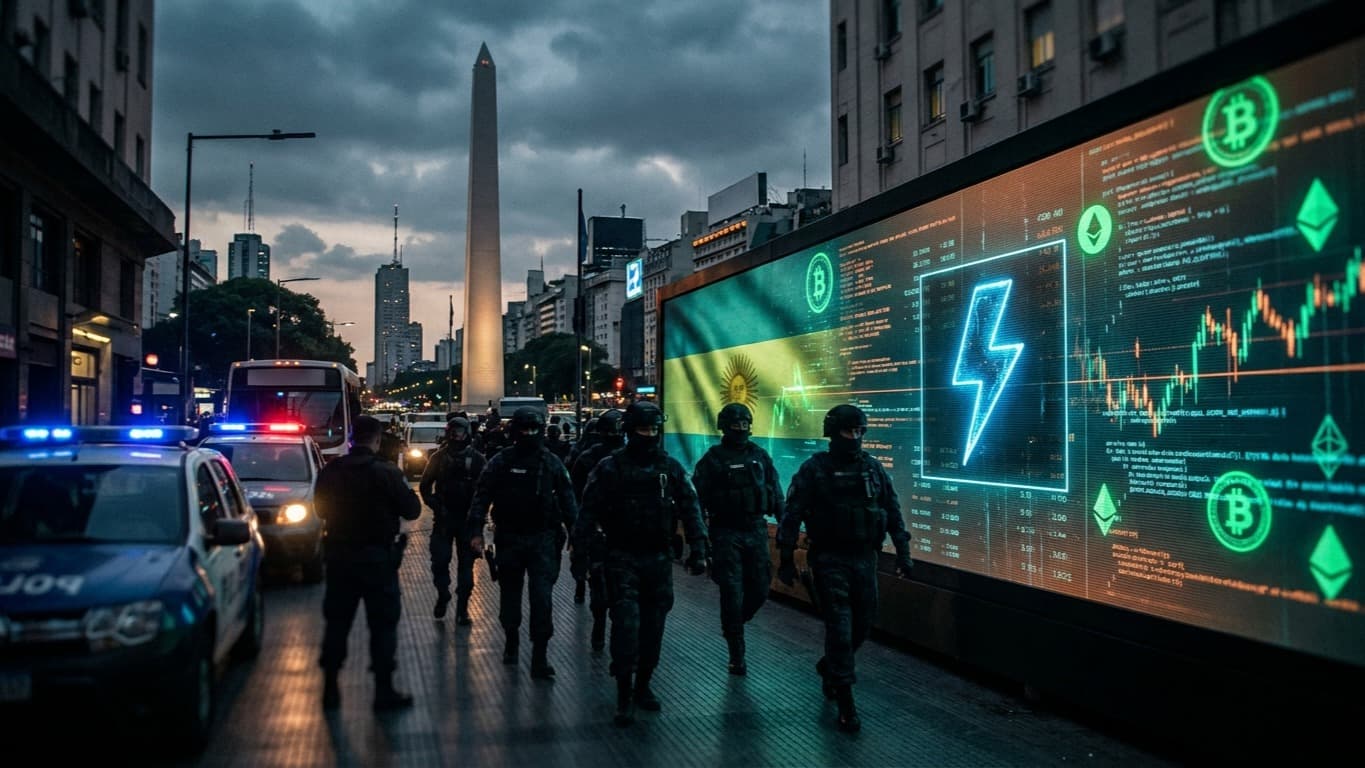
May 4, 2026 will be recorded in three jurisdictions simultaneously. In Brasília, the Central Bank of Brazil activated Resolution 521, equating cryptocurrency movement to foreign exchange operations. In Washington, the market was pricing the Tillis-Alsobrooks commitment that unlocks the CLARITY Act. And in Buenos Aires, on a Thursday of simultaneous operations in three city districts and two more municipalities in the metropolitan region, the City Police executed 21 search warrants, arrested eight people and blocked US$ 250 thousand in cryptocurrency, cash and Argentine pesos.
The mapped scheme had two families united in a family structure, more than 200 victims scattered throughout Argentine territory and a fraud engineering that updated the classic pyramid for the crypto era. The operation has no media name — it wasn't named "Operation X". But it has what matters: coordinated structure, clear legal basis for classification, on-chain capture of illicit wallet and investigative sequence starting from provincial complaint in Puerto Madryn through execution in Buenos Aires. It's exactly the type of operation that Brazil still doesn't know how to replicate with regularity.
The operation in numbers
Official data consolidates the scope of the action. There were 21 search warrants: twelve in central Buenos Aires zones (Retiro, Saavedra and Belgrano neighborhoods) and nine in municipalities in the metropolitan region (San Isidro and Morón). Eight defendants were formally charged, and a ninth individual was arrested with an outstanding arrest warrant issued by La Rioja province for prior crimes.
The seizures total US$ 250 thousand distributed across three distinct categories. Approximately US$ 80 thousand in cryptocurrency were blocked via on-chain freezing — the relevant technical detail is that Argentine police managed to lock the digital asset before the suspects could move it. US$ 172 thousand in physical currency were seized during searches. 6 million Argentine pesos in local currency. Added are high-value checks, various vehicles, hundreds of cell phones, laptops, documents with financial movement notes and hard drives now under forensic analysis.
The procedural coordination originated from prosecutor Fernando Rivarola, based in Rawson, capital of Chubut province, in far southern Argentina. The initial complaint came from Puerto Madryn — a port city of just over 100,000 residents — and the procedural path demonstrates exactly what the Brazilian model has difficulty operating: a provincial complaint reached simultaneous execution in the national capital without loss of coordination.
The fraud engineering
The scheme didn't invent a new method. It updated the classic pyramid for crypto vocabulary. The cycle is simple and operated in four repeated steps.
Step one: the victim was approached with a promise of high returns via "closed partnerships and exclusive financial papers," sold as a product reserved for restricted circles. Step two: they received access to a proprietary application that displayed increasing balances, with simulation of compound returns in real time. The application was exclusive, controlled by operators, with no external audit. Step three: for approximately one month, the victim watched gains growing on the screen, and could even make small initial withdrawals — the typical proof-of-concept mechanism that anchors trust. Step four: when trying to withdraw larger amounts, the victim received fabricated justifications — "central bank bureaucratic obstacles," "additional compliance verification," "tax requalification" — until contact was simply cut off.
The model is pure Ponzi with a crypto layer on the surface. The most serious fact is the scale: more than 200 victims registered throughout Argentine national territory. In an individual case highlighted by the proceeding, a single victim had invested more than 100 million pesos without ever managing to withdraw. At the approximate peso rate, the individual amount exceeds US$ 100 thousand — which indicates that the target audience wasn't uninformed retail in low volume, but middle-market investors with the capacity to make significant contributions.
The money laundering engineering
The second level of the operation — and what interests the reader following financial threat intelligence most — is the laundering structure. The organizers didn't simply accumulate the proceeds from the fraud; they moved the money through five parallel mechanisms for clean re-entry into the formal system.
- Repeated fiat↔crypto conversion. Pesos were converted to stablecoins, then to another crypto asset, then back to fiat — often in jurisdictions with less scrutiny before return. Each hop adds a layer of on-chain obfuscation.
- Luxury vehicles. Purchase of automobiles registered in their own names or third parties', with eventual resale for realization of formal "capital gains."
- Import of electronics for resale. Documented import of equipment, with resale via formal Argentine channels. Allows issuance of invoices and appearance of legitimate commercial activity.
- Clandestine exchange houses disguised as travel agencies. This is the most elaborate documented mechanism. Commercial establishments formally registered as travel agencies operated, in practice, as parallel foreign exchange operations (cueva). They served customers with false travel packages but sold dollars and crypto outside the formal circuit. A recurring model in jurisdictions with foreign exchange controls — Argentina, with historical exchange restrictions, offers fertile ground.
- Properties simulated via residential rental. Fabricated rental contracts, paid in cash, creating a history of "real estate income" to justify entry of resources into the formal system.
The whole set is a union card of laundering. Each individual mechanism is, in isolation, a lawful commercial activity. The serial combination — fiat-crypto-vehicle-electronic-parallel exchange-property — produces transaction volume that confuses traditional banking tracing and requires analysis combining on-chain investigation with retail intelligence. It was exactly this type of integrated analysis that the City Police's Division of Technology Crimes was able to execute.
How Argentina reached the operation
The procedural path is instructive. It all started with formal complaints filed in Puerto Madryn — a city on the Patagonian coast — by local victims. Prosecutor Fernando Rivarola, working in provincial capital Rawson, built the initial investigation and identified that the head of the operation operated from Buenos Aires. Coordination then escalated: Buenos Aires City Police entered via the Division of Technology Crimes (DDT), a specialized unit combining digital forensics with financial intelligence. The final execution was simultaneous in capital and municipalities in the metropolitan region, with 21 warrants issued at synchronized times.
Three structural elements enabled the sequence. First, the legal basis: CNV Resolution 1069 and the BCRA framework that allowed banks to offer cryptocurrencies gave police explicit normative basis to classify crypto fraud as a classified financial crime, not generic fraud. Second, the specialized unit: DDT exists nominally, with defined mandate and permanent technical staff, capable of operating on-chain analysis combined with on-ground intelligence. Third, inter-jurisdictional coordination: provincial complaint reached execution in capital without loss of federal-provincial coordination time. The Argentine model is decentralized, but functional.
The Brazilian contrast
Brazil has similar operations. The Federal Police have dismantled crypto schemes via Operation Copacabana, there are occasional operations in Maranhão, São Paulo, Rio de Janeiro. Technical expertise exists in specialized state police departments. What's missing — and the Argentine case exposes with clarity — is structure that combines three elements: regular public cadence, nominally specialized federal unit and standardized inter-jurisdictional coordination.
Each Brazilian operation seems to reinvent the wheel. The legal basis varies: some cases are classified as fraud (article 171), others as crime against the national financial system (Law 7,492), others as financial pyramid (Law 1,521/51). Without explicit regulatory framework that classifies financial crime with cryptoasset autonomously, the prosecution needs to build legal argument case by case. In our reading of the 2026 Chainalysis report, we showed that Brazil appears nominally as the origin of crypto flow to human trafficking networks in Southeast Asia. There is, however, no equivalent Brazilian public statistical instrument that measures the size of equivalent domestic fraud flow. In Argentina, 200 victims in a single operation. In Brazil, perhaps 200,000 scattered, without aggregated mapping.
When we analyzed the RWA scenario Q1 2026 with US$ 19.3 billion, we showed that Brazil is off the institutional map of tokenization. The Argentine operation exposes the other face of the same phenomenon: the absence of explicit framework doesn't only affect institutional capital that chooses other jurisdictions. It also affects the ability to protect citizens from fraud that uses the regulatory vacuum to operate.
The other side: Argentina isn't nirvana
An editorial caveat is needed. Enforcement capacity is a necessary condition, not sufficient. The LIBRA scandal, with Milei connected by call logs to the businessman responsible for the US$ 250 million rug pull, shows that even with regulatory framework and competent police operation, the Argentine political frontier is still fragile. When the head of state himself associates with a launch that ends in fraud worth hundreds of millions of dollars, the institutional structure can't shield.
The point is exactly that, however. Argentina, even with the LIBRA challenge, operates both in macro (institutional CNV 1069) and in micro (Buenos Aires operation with 200 victims). Brazil still doesn't have either of them in the formal terms that the operation demonstrated. With 20% crypto adoption and the largest stablecoin market in Latin America, the southern neighbor built, in parallel, regulatory capacity and investigative capacity. Brazil first built foreign exchange regulation (Resolution 521) without building the tokenization framework or the specialized enforcement unit. VECERT mapped 32 active actors against Brazilian targets and 29.8 TB exfiltrated in 90 days, but the work remains private, with no public counterpart with equivalent cadence.
Why the Argentine case matters for Brazil
There's a pattern emerging in post-2025 Latin America. Argentina gave the crypto starting signal with CNV including digital assets in investor assets, then with CNV 1069 on tokenization, then with BCRA freeing banks. In parallel, it built a specialized enforcement unit. The result is a virtuous cycle: legal framework facilitates investigation, investigation generates public data, public data feeds regulatory refinement.
Brazil has loose pieces. PL 4,308 still stuck in Congress. BCB Resolution 521 activated with foreign exchange scope. BCB Resolution 561 limiting crypto in international payment. CVM working tokenization regulation case by case. Specialized police units existing in some states, without standardized national coordination. Result: each operation is individual, each case reinvents the classification, and the national statistical picture remains unclear.
Each exemplary Argentine operation published in international press increases comparative pressure on Brazil. The regulated Brazilian crypto sector — exchanges, custodians, managers — has direct interest in the arrival of explicit framework, because it operates today in terrain that punishes indistinctly the regulated agent and the clandestine operator. When 8 suspects are arrested in Buenos Aires and the news crosses borders, the Brazilian sector argument that "regulation is a brake on innovation" loses credibility. Argentina demonstrated that regulation is a precondition for protection.
The ON3X perspective
Three readings to metabolize the Argentine operation and what it means for Brazil:
- Enforcement capacity goes hand in hand with regulatory framework — Argentina proves that the correct sequence is to regulate first, then supervise and punish. Brazil is doing the opposite: forcing foreign exchange rules via Resolution 521 without building explicit tokenization framework or federal enforcement unit. The cost of this inversion appears in statistics that don't exist: no one knows how many Brazilian victims per year fall into pyramid schemes equivalent to Buenos Aires'. Without public measurement instrument, there's no basis to refine public policy. Argentina created the instrument by creating the framework. Brazil needs to do the same, and time is running out.
- Two hundred victims in a single Argentine operation is a number that puts into perspective the Brazilian gap in financial threat intelligence. In an economy three times larger than Argentina's, Brazil should conservatively have three times more victims of the same type of fraud per month. There's no equivalent public mapping. When the 2026 Chainalysis report listed Brazil among the top five sources of crypto flow to human trafficking networks in Southeast Asia, it showed one exposure vector. The Argentine operation shows another: domestic fraud at invisible scale. Building national capacity for financial threat intel is as urgent as building explicit regulatory framework.
- The Argentine decentralized model — provincial complaint reaches execution in capital — is replicable in Brazil. It doesn't require constitutional reform, doesn't require creating a new agency. It requires a nominally specialized federal unit with explicit mandate, classified legal basis and standardized coordination with state Public Ministry. Low institutional cost, high deterrence return. The political window is short: each exemplary Argentine operation accumulates pressure on Brazil to replicate. The regulated Brazilian sector can lead this pressure, and has direct incentive to do so.
Frequently asked questions
What happened in the Argentine operation on May 4?
Buenos Aires City Police, via the Division of Technology Crimes, executed 21 search warrants in three city districts and two municipalities in the metropolitan region, arrested eight formally charged people and blocked the equivalent of US$ 250 thousand in cryptocurrency, cash and Argentine pesos. The operation dismantled a crypto pyramid scheme that victimized more than 200 people throughout Argentine national territory, with procedural coordination originating from prosecutor Fernando Rivarola, in Rawson, Chubut province.
What type of fraud were the criminals running?
Ponzi pyramid with a crypto layer. Victims were approached with a promise of high returns in "closed partnerships and exclusive financial papers," received access to an exclusive application controlled by operators, watched fabricated gains growing for approximately one month, and when trying to withdraw larger amounts received false justifications — "central bank obstacles," "additional verification" — until contact was cut off. In one individual case, a victim had invested more than 100 million Argentine pesos without ever managing to withdraw.
How did the scheme launder the money?
Five parallel mechanisms: multiple fiat↔crypto conversion, purchase of luxury vehicles, import of electronics for resale in formal channels, clandestine exchange houses disguised as travel agencies, and simulated residential rental contracts. The serial combination of all five produced transaction volume that confused traditional banking tracing, requiring on-chain analysis combined with retail intelligence to dismantle.
How did Argentina manage to dismantle the scheme?
Three structural elements. Explicit legal basis via CNV Resolution 1069 and BCRA framework, which classifies crypto fraud as an autonomous financial crime. Specialized unit — Division of Technology Crimes of the City Police — with nominal mandate and permanent technical staff. Standardized inter-jurisdictional coordination, allowing a complaint from a Patagonian port city (Puerto Madryn) to reach simultaneous execution in the national capital without loss of federal-provincial coordination time.
Why does this operation matter for Brazil?
Because it exposes the Brazilian gap: Brazil has occasional police operations against crypto fraud, but doesn't have regular public cadence, nominally specialized federal unit with explicit mandate, or regulatory framework that classifies crypto fraud autonomously. Each Brazilian case reinvents the classification and coordination. In an economy three times larger than Argentina's, Brazil should conservatively have three times more victims of the same type of fraud per month — with no equivalent public mapping. Building explicit framework and specialized unit is a precondition for enforcement at scale.