

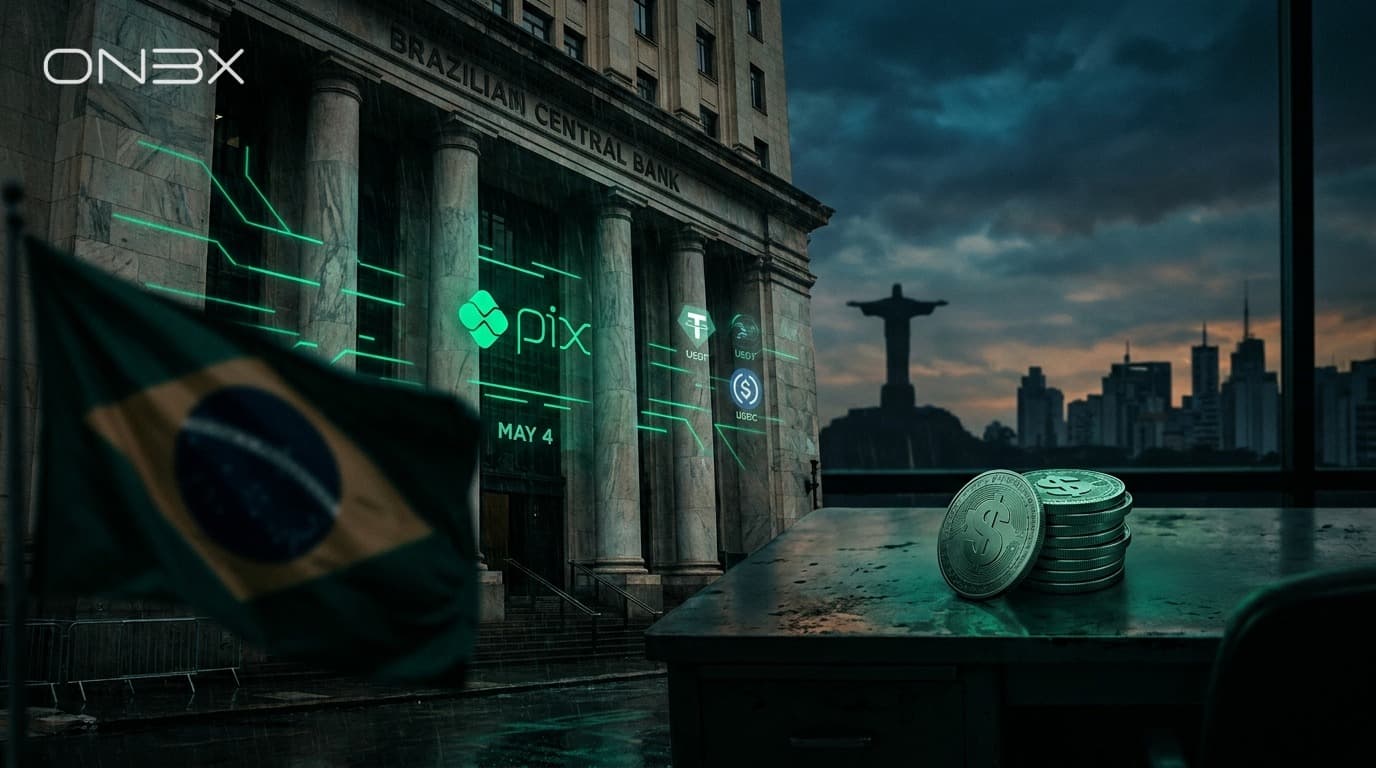
In 10 days, the way Brazil views cross-border crypto flow changes permanently. Starting May 4, 2026, every virtual asset transaction that has origin or destination outside national territory becomes reportable to the Central Bank, with mandatory detail of value, purpose, counterparty and country involved. It's no longer optional. It's no longer a gray area. It's foreign exchange — and foreign exchange that the BC sees in near real-time.
The shift is part of the package of Resolutions BCB nº 519, 520 and 521, published in November 2025 and that came into force in February of this year. But in May, the foreign exchange regime effectively "turns on" — and anyone operating with crypto in Brazil at any scale needs to understand what this means before it becomes an operational, tax or criminal problem.
What takes effect exactly on May 4
The central obligation is simple in statement and complex in execution: every international operation settled in virtual assets — including stablecoins like USDT and USDC — formally becomes part of the Brazilian foreign exchange market. In practice, this means each cross-border transfer must be reported to the BC with five mandatory fields:
- Value in dollars and its equivalent in reais at the day's rate.
- Economic purpose of the operation (service payment, import, investment, family remittance, OTC, etc.).
- Counterparty, with identification of recipient/sender.
- Country of origin or destination.
- Proof of origin and destination of resources when required by the operation's profile.
Reporting is the obligation of the SPSAV (Virtual Asset Service Provider Company) — a legal entity created by Resolutions 519/520/521 that replaces the regulatory limbo where national and foreign exchanges operated until now. Whoever is a SPSAV reports. Whoever isn't, but operates in this perimeter, is in an irregular situation as of May 4.
Who is affected, and who still thinks they aren't
The scope is broader than it appears. Those obligated include:
- Brazilian exchanges (Mercado Bitcoin, Foxbit, Bitybank etc.) — all need to be authorized as SPSAV by October.
- Foreign exchanges operating in Brazil — Binance, Coinbase, Bitso and similar need a local entity or partnership with an authorized SPSAV to serve Brazilian clients.
- Payment companies using stablecoin for international settlement — fintechs offering "international Pix via USDT", multi-currency accounts, B2B gateways.
- Corporate clients using crypto for overseas supplier payments, exporters receiving in USDC, or treasuries with digital asset positions.
- OTC traders who intermediate crypto capital inflow and outflow.
What still creates confusion: self-custody. The initial reading of the resolutions was that personal wallets were out. That's not the case. When the user sends crypto to a wallet in another jurisdiction — or receives from one — the operation is cambial and requires holder identification and proof of origin and destination at the moment of entry or exit from the regulated ecosystem. In other words: you can use self-custody, but the moment you convert crypto to reais (or vice versa) at a SPSAV is the capture point.
Stablecoins: the real trigger for all this machinery
The engine behind this regulation isn't bitcoin. It's stablecoin. The Central Bank observed, throughout 2024 and 2025, that USDT and USDC became the preferred international remittance instrument for medium and large Brazilian companies, bypassing banking spreads and IOF on traditional foreign exchange operations. Volume grew silently, to the point where the BC's own division chief publicly declared that stablecoins are issue number one on the 2026 regulatory agenda.
We've already covered parallel movements: the USDC integration with Pix announced in April, which creates a BRL/USD conversion stack in real-time, and the regulatory race between Brazil, the USA and the EU, with Washington asking for more time while Brasília accelerates. May 2026 is when the BC closes this loop: stablecoin in Brazil stops being "pure" digital asset and becomes a regulated foreign exchange instrument in all practical effects.
How reporting will work in practice
Operationally, reporting follows the Sisbacen model with specific crypto adaptations. Authorized SPSAVs integrate their systems with BC infrastructure and send, in structured format, each operation that crosses a border. Volumes will be visible to the BC practically in real-time — there's no longer the historical months-long delay of classical foreign exchange reports.
For the end client, what changes is the KYC flow and proof of origin. Someone buying US$ 50,000 in USDT to pay a Chinese supplier needed, at most, the exchange's standard KYC. Starting in May, the SPSAV can (and in many cases should) demand an invoice, import contract, invoice or other document proving the stated purpose. Operations without documentation are subject to refusal or precautionary blocking until clarification.
Another point: the simplified operations limit. The BC maintained the US$ 10,000 ceiling for low-risk operations with reduced documentation. Above that, documentary proof is mandatory.
October 2026: the second deadline that changes everything
May is the foreign exchange reporting entry point. October is the deadline for all companies operating in this perimeter to be authorized as SPSAV. As we've already covered in the unified compliance deadline, incumbents like Itaú, Nubank and Mercado Bitcoin start from the same point as smaller fintechs. Whoever doesn't have authorization by then loses the right to operate for Brazilian clients.
The three authorization pillars are:
- Reputation — history of partners, absence of administrative proceedings, reputational integrity.
- Economic capacity — minimum capital, audited financial statements, continuity plan.
- AML structure (anti-money laundering prevention) — dedicated team, auditable processes, on-chain monitoring tools.
A predictable side effect: sector consolidation. Small national exchanges without capital to build this structure tend to be absorbed by incumbents or shut down. The regulatory cost of operating legally went up — and the Central Bank made clear, in public statements, that it won't pause regulatory speed at the sector's request.
Brazil vs. USA, EU and Argentina: what everyone is doing
The international contrast makes Brazilian acceleration even more clear. In the USA, the GENIUS Act faces resistance from major banks, which ask for more implementation time — a situation we detailed in American Banks Ask for More Time in GENIUS Act. In the European Union, MiCA is fully implemented, with CASP deadline in July. In Argentina, the BCRA just freed banks to offer crypto and also created its own tokenization framework.
Brazil is today, ahead of any Western Hemisphere country in terms of operational crypto foreign exchange regime. This is, simultaneously, a competitive advantage to become a regional international payment hub, and a risk if acceleration discourages local innovation.
What the company exec needs to decide in the next 7 days
For companies using crypto in any part of the cross-border flow, three decisions become urgent:
- Complete mapping of current cross-border crypto flow. How much goes out and comes in, in which stablecoin, with which counterparty, in which country? Without this inventory, no reporting is possible on May 4.
- Validation of the SPSAV you use. Is the exchange or platform you use today authorized? Does it have a Brazilian entity? Is it on the path to authorization? If the answer is "I don't know", the risk is stopping operations in May without warning.
- Retroactive documentation. Operations from the past 12 months can be requested for verification. Invoices, contracts, payment receipts — everything needs to be filed and ready to be pulled.
Companies that depend on crypto remittance to Chinese suppliers, international SaaS payments or OTC settlement have a short window to adjust. Anyone treating it as a quarterly priority is behind.
The ON3X perspective
Three takeaways to close.
One: crypto in Brazil stepped off the regulation frontier. It's at the center of it. The BC's speed between Nov/2025 and May/2026 — six months between publication and full operation of a foreign exchange regime — is uncommon even by Brazilian standards. There's no longer "I'll wait and see" as a company strategy.
Two: the era of crypto-foreign exchange regulatory arbitrage has ended. Whoever used USDT to escape banking spreads and IOF won't be able to continue silently. The BC will see it. Hacienda will see it. The Federal Revenue Service will see it. The operation remains possible — but it needs to be formalized and justified.
Three: there's a concrete positive side. Companies that do formalize gain access to the same regulated track that banks use, with volume and stability. International payment via regulated stablecoin can, yes, become cheaper and faster than SWIFT — except now within the law, with an invoice, with proof of origin, with known counterparty. The informal shortcut is over. The regulated path has begun.
The question the Brazilian C-level needs to be answering this week isn't "should I comply?". It's: "who is responsible internally for ensuring we'll be ready on day 4?". If you don't have a name yet, you're behind.