

The Alert: VECERT Exposes A Paradigm Shift in Crypto Fraud
The VECERT Analyzer, a cyber threat intelligence platform, detected the commercial launch of a tool that security experts have been anticipating for two years — and which is now finally here, at industrial scale. Its name is JINKUSU CAM, and its value proposition is brutally straightforward: break facial verification ("biometric KYC") of the world's largest exchanges in real-time, with enough quality to fool liveness check systems.
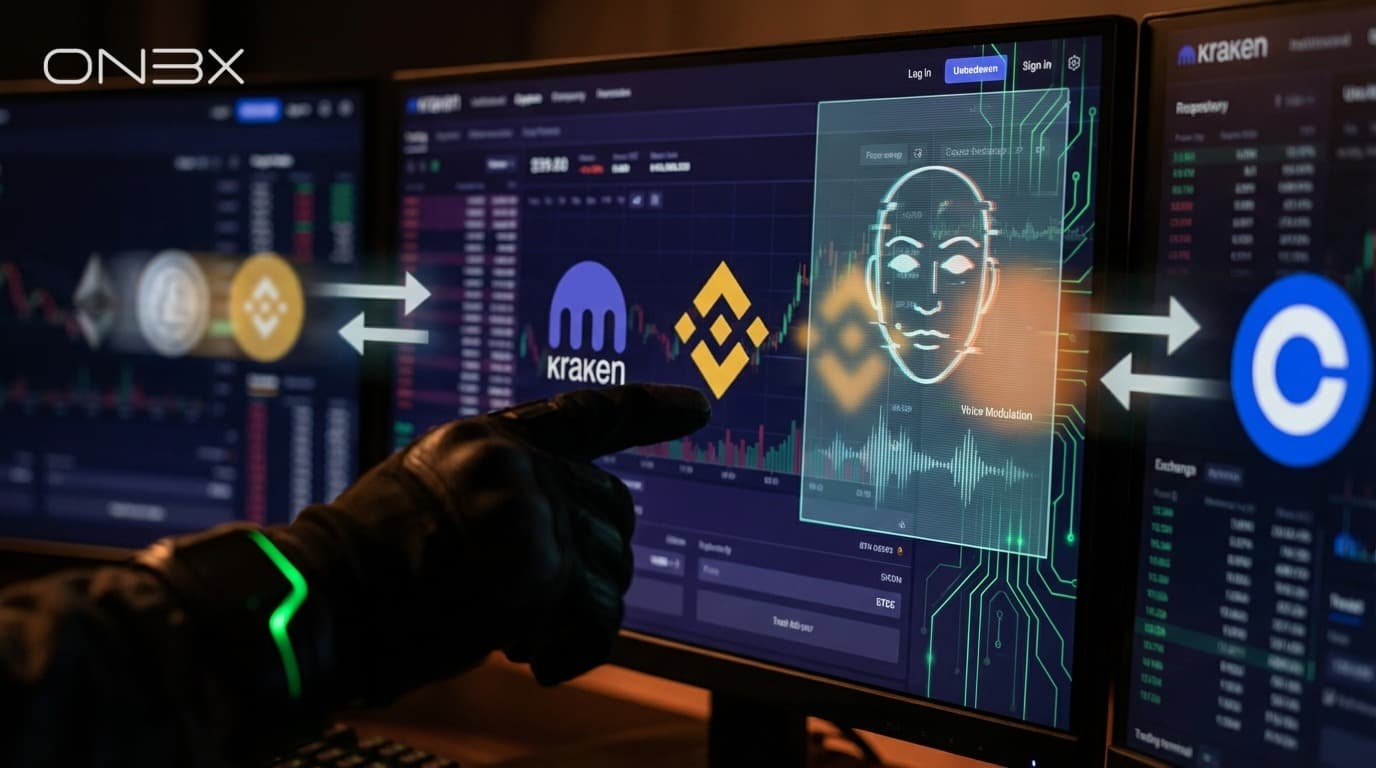
Pre-configured to operate against Binance, Coinbase, Kraken and other top platforms, JINKUSU CAM is sold as a finished product — any criminal, with no technical background whatsoever, can operate it. The effect, in VECERT's words: "the end of facial verification as a security standard in crypto onboarding".
What is Liveness Check and Why It Mattered
Top exchanges don't just accept an ID photo for KYC. They require that the user, during registration, execute a series of gestures in front of the camera:
- Blink
- Turn your head to specific sides
- Smile on command
- Recite a phrase or number generated in real-time
This sequence, called liveness check, was designed to defeat simple attacks — printed photos, recorded videos, 3D masks. For years, it worked. Static photographs don't blink. Videos don't respond to random commands. Masks don't have natural microexpressions.
JINKUSU CAM breaks all of this in real-time.
The Technical Mechanics
Face Swap Via InsightFace
The technical heart of JINKUSU CAM is InsightFace, an open-source facial recognition and face-swapping library developed for academic research. The tool uses GPU acceleration to:
- Detect the victim's face (obtained via leaked photo, social media, or even document photo)
- Map facial landmarks in real-time (eyes, mouth, contour, nose)
- Overlay the victim's face onto the kit operator's face, live
- Transfer gestures from the operator to the synthesized face — the attacker blinks, turns their head, smiles, and the victim's avatar does the same
The result passes to the camera as if it were a legitimate video stream. Liveness check systems see a real person executing the requested gestures — but the real person is the criminal, just with their face digitally "painted" with someone else's identity.
Voice Modulation Layer
Some exchanges reinforce KYC with voice verification — asking the user to read a phrase or code. JINKUSU CAM includes a real-time voice modulation layer, capable of:
- Imitating the target voice's tone and timbre, from short samples
- Adjusting prosody (rhythm, pause, intonation) to sound natural
- Operating with latency low enough for "live" interactions
Combining face swap + voice modulation, the kit operator can fully simulate another person's identity in a video call with a human operator — not just in an automated verification.
Pre-Configuration For Pig Butchering
One of the most alarming features documented by VECERT is that JINKUSU CAM comes pre-configured for pig butchering schemes — the famous "pig slaughter," long-term relationship scams that end on fake investment platforms.
How The Pig Butchering Scheme Works
- Criminal contacts victim via Tinder, LinkedIn, WhatsApp, or Telegram
- Builds relationship over weeks or months — romantic, friendship, mentoring
- Gradually introduces crypto investment topic — "my uncle works in finance and taught me a method..."
- Convinces victim to register on "exclusive platform" (controlled by criminals)
- Victim deposits, sees fake profits, deposits more, and when trying to withdraw discovers the money is gone
Where JINKUSU CAM Comes In
Traditional pig butchering depends on video calls to establish trust — the victim wants to see the face behind the chat. With JINKUSU CAM:
- The criminal presents themselves as an executive from a real company, using the face of a verifiable public figure on LinkedIn
- Participates in convincing calls — laughter, gestures, natural microexpressions
- Can change identity as needed, operating multiple identities in parallel
- When the victim questions, a "video call with the compliance officer" (another deepfake) resolves it
The Impact On Major Exchanges
Binance, Coinbase, Kraken
All three platforms are mentioned by name as pre-configured targets of the kit. All three have:
- Mandatory facial verification for advanced KYC
- Liveness check by gestures
- In some cases, periodic reverification or for high-value operations
The exploit means that a criminal can:
- Obtain a leaked identity document (there are millions in dark web forums)
- Use real photo from document + face swap via JINKUSU CAM
- Create a KYC-verified account in the victim's name
- Use that account for money laundering, receiving stolen funds, or for receiving payments from victims in schemes
Traditional Banks Too
It's not just crypto. Digital banks (Revolut, Nubank, N26, Wise) that operate 100% remote KYC use the same technologies — and are equally vulnerable. The gravity of JINKUSKU CAM transcends the crypto ecosystem; it affects the entire digital identity financial architecture.
Industry Responses
Cyvers (Deddy Lavid)
Deddy Lavid, CEO of blockchain cybersecurity firm Cyvers, classified the tool's launch as "a wake-up call for the financial industry". The company is working on detection solutions that analyze:
- Compression artifacts typical of face swap
- Inconsistencies in lighting between face and background
- Anomalous patterns in eye movement and blinking
Exchanges
Official responses were cautious and incomplete:
- Binance: reinforced that it uses "multiple layers of verification" and invests in deepfake detection, without details
- Coinbase: stated partnership with leading biometry vendors (not specified)
- Kraken: opted for public silence, but internal sources indicate complete review of KYC flows
Regulators
In the US, FinCEN and OFAC are monitoring the case, with specific concern about money laundering facilitation. In the EU, discussion is ongoing about whether MiCA and banking regulations need to include minimum deepfake resistance requirements in KYC. In Brazil, the Central Bank and CVM are at the stage of understanding the impact before commenting.
What Comes Next: The Future of KYC
Multi-Factor Identity
The immediate lesson: isolated facial verification is no longer sufficient. Emerging solutions combine:
- Facial biometrics + microexpression analysis (difficult to synthesize in real-time)
- Document verification via NFC chip (biometric passports, chip-enabled ID)
- Voice biometrics with on-the-fly generated phrase challenges
- Keystroke dynamics — how a person types
- Cross-device fingerprinting with historical records
- Live video verification with trained human operator
Proof of Personhood
Projects like Worldcoin (iris scan via Orb) and Humanity Protocol (palm scan) push toward more robust physical biometrics, difficult to replicate digitally. Controversial in the privacy space, but technically more resistant to deepfakes.
Zero Knowledge Proofs
A radical direction: instead of proving that you are "John Smith with SSN X," prove that you are "a unique human, over 18 years old, not listed on blacklists" — all via ZK proofs that don't expose real identity. It preserves privacy and, if well implemented, resists face swap because identity is not the face.
How Users Protect Themselves
Against Unauthorized Use of Your Identity
- Strict control of your photos online — especially photos of documents. Avoid posting high-resolution face photos on open networks
- Credit bureau alerts — enable notifications for any new financial account opened in your name
- Monitor your ID number periodically through official services (Serasa, Boa Vista, or equivalent in your country)
- Maintain an "official" account on each major exchange — keeping the account active with strong 2FA prevents a criminal from opening a duplicate account in your name
Against Pig Butchering
- Be suspicious of relationships that quickly pivot to investments — classic pattern
- Never trust "investment platforms" discovered via personal introduction
- Verify video calls by asking for unexpected gestures — move your ear, show an object from your environment, place your hand in front of your face at an unusual angle (deepfakes fail on extreme occlusion)
- Never pay "taxes" or "withdrawal fees" on unknown platforms — always a scam
The Bigger Implication: The Future of Digital Trust
JINKUSU CAM is merely the materialization of a technical inevitability. High-quality real-time face swap was a question of "when," not "if." Its release as a packaged product merely democratizes a capability that previously required significant technical knowledge.
The deeper implication: for centuries, our common sense has been "seeing is believing". A video call was near-absolute proof of identity. That has silently changed, and JINKUSU CAM is the most visible symbol of this transition. In the near future:
- Journalism will need to revise policies for verifying sources on video
- Courts will need to discuss the admissibility of video as evidence
- Families will need to establish "codewords" against fraud with synthetic relative voices
- Digital identity systems will need to evolve radically
Conclusion: Welcome to the Post-Biometry Era
Biometric KYC is dead. Not officially, not all at once — but its illusion of security is over. As VECERT observed, JINKUSKU CAM is not an isolated case; it is the commercial materialization of a new risk category. What comes next will require regulatory creativity, technical investment, and user literacy at levels the industry has yet to demonstrate it possesses.
For exchanges, the race is for identity architectures that make deepfake of face and voice insufficient. For regulators, the race is for frameworks that acknowledge standard KYC no longer protects. For users, the race is for awareness that their own image, their own voice, their own document are exposed and commodified.
Meanwhile, JINKUSKU CAM continues to be sold. And someone, right now, somewhere, is opening an account on an exchange using someone else's face — someone who doesn't even know it.
Primary source: VECERT Analyzer alert published in April 2026. Information cross-referenced with Cyvers, Cointelegraph, Biometric Update, and industry coverage.
Disclaimer: This content is informational and educational. It does not constitute investment recommendation. In case of suspicion of fraud involving your identity, immediately contact your region's cybercrime police department and notify the exchanges and banks where you operate.