

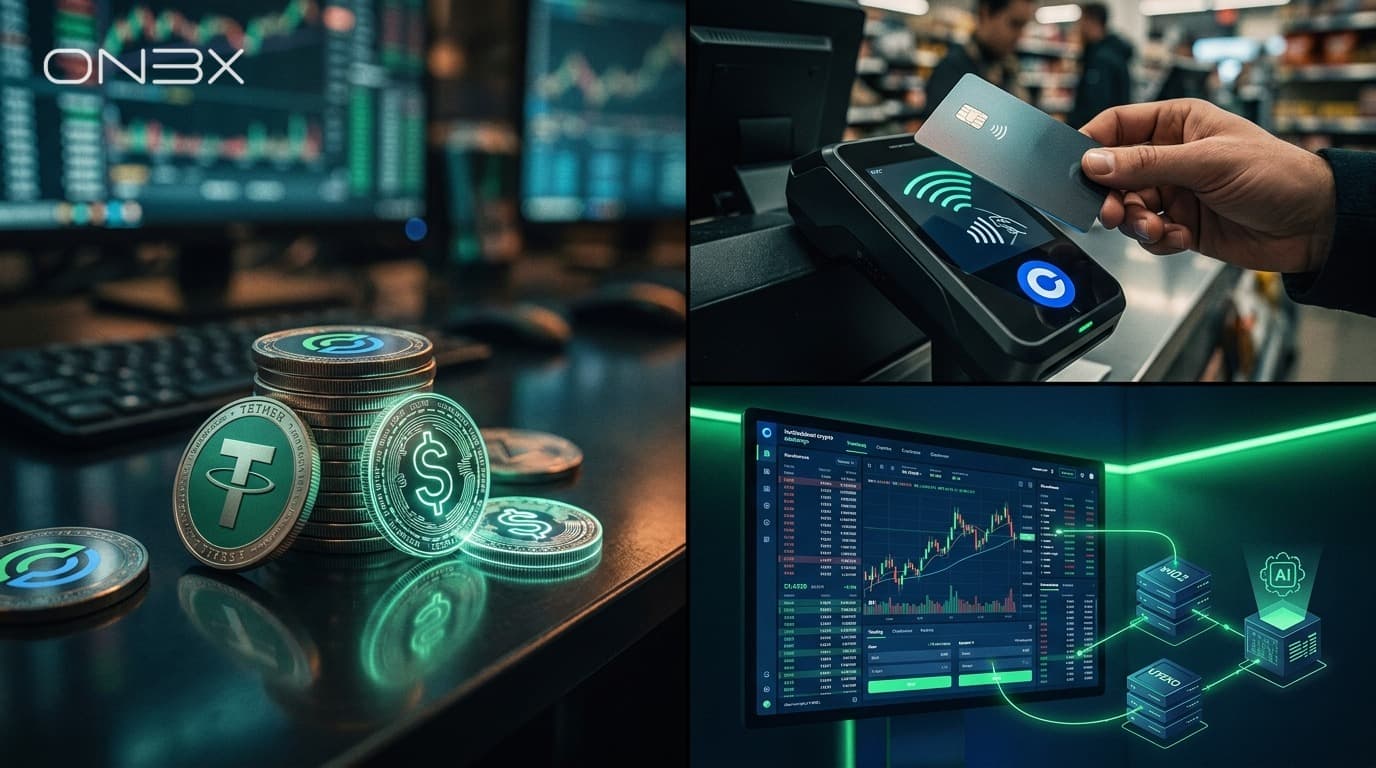
On April 16, 2026, without fanfare and in an announcement that barely made that day's crypto headlines, Utexo — a startup founded by Paolo Ardoino, former CTO of Tether — closed an integration with the x402 protocol, a standard created by Coinbase in partnership with Cloudflare. The practical result fits in one sentence: artificial intelligence agents can now pay for any service on the internet using USDT, with settlement in 50 milliseconds and without creating an account, without depositing balance in advance, without a human in the middle.
For those outside the crypto-AI cycle, this seems like a technical detail. In reality, it's one of the most significant infrastructure moves of the year — and could be the missing piece for the autonomous agent economy to move from PowerPoint to the monthly revenue of major software companies.
The status code that has been forgotten since 1997
Every web programmer knows 404 Not Found. Many know 500, 403, 301. Almost nobody used HTTP 402 — Payment Required. The code has existed since the first version of the HTTP protocol, reserved since 1997 for "future use". No major framework, browser, or server actually implemented anything with it. It sat there, like a locked hallway of the standard, waiting for someone to find the key.
In May 2025, Coinbase found it. x402 was launched as an open protocol that transforms 402 into a real billing mechanism embedded in HTTP calls. The flow is elegant in its simplicity:
- A client (can be a human, an app, or increasingly an AI agent) makes a request to an endpoint;
- The server responds with
HTTP 402 Payment Requiredplus a header containing price, accepted assets, and network; - The client assembles a signed payment payload and resends the request;
- A Facilitator — a service hosted by Coinbase, third parties, or the developer themselves — verifies the signature and settles on-chain;
- The server releases the resource.
No login. No OAuth. No "register your card". No session. The standard is stateless by design — perfectly aligns with how AI agents operate, which is making API calls in volume without maintaining state between them.
First-year numbers show real traction: between May and December 2025, x402 processed 75 million transactions totaling $24 million in payments — almost all coming from paid APIs and AI agents buying access to data, model inference, and third-party services. The average ticket ($0.32 per transaction) screams the real use case: micropayments, something traditional internet tried and failed to enable for three decades.
The limitation that USDT's arrival solves
Until the April 16 integration, there was an annoying detail in x402: the protocol officially accepted only USDC as a payment method. It makes sense from Coinbase's perspective — the company is co-issuer of USDC and the standard was born in an EVM ecosystem where USDC dominates. But the world's largest stablecoin was missing.
USDT today has over $150 billion in circulation, which is almost double USDC. In emerging markets — Brazil, Argentina, Turkey, Nigeria, Southeast Asia — USDT is the digital dollar. Any protocol that wants to become a global payment standard without supporting it is basically ignoring half the world.
With the new integration via Utexo, x402 gains USDT as a primary settlement option. The door opens for APIs, agents, and autonomous systems to accept the most liquid stablecoin on the market — not via bridge, not via wrapped token, but natively.
Who is Utexo and why it exists
Utexo was founded by Paolo Ardoino, a central figure in the stablecoin world. Ardoino was for years CTO of Tether, the company behind USDT, and in 2024 became CEO. In March 2026, he left to run Utexo full-time — bringing with him the most relevant political capital in this ecosystem.
Utexo's positioning is surgical: native USDT settlement on Bitcoin. Not on Ethereum L2, not on Tron, not on Solana. On Bitcoin. The architecture combines three layers:
- Bitcoin base layer for security and final settlement;
- Lightning Network for fast transport between nodes;
- RGB protocol to represent assets (USDT) outside the public on-chain layer.
On March 6, 2026, Utexo closed a seed round of $7.5 million led by Tether itself. In April, it officially joined the Linux Foundation, a sign that the project aims for global infrastructure positioning, not niche product.
Why Bitcoin, and not an Ethereum L2?
Ardoino's choice is both ideological and technical. In public statements, he argues that Lightning — with its peer-to-peer node topology — offers privacy and censorship resistance that no L2 based on a centralized sequencer can deliver.
The argument is not rhetorical. Optimism, Arbitrum, and Base operate with sequencers controlled by their own development teams. In theory, a court order could freeze transactions at the moment they pass through the sequencer. In Lightning, with decentralized routing and private channels, there's no single point to compress.
Another relevant point: in Utexo's architecture, fees are charged in USDT, not satoshis. For a merchant, this means predictability — you don't need to worry if BTC will rise and fees get expensive. For an AI agent making hundreds of micropayments per minute, avoiding volatility in the base asset is practically a requirement.
What this unlocks: the agent economy (A2A)
The Agent-to-Agent economy — or A2A — is the term coined for the pattern in which AI agents transact with each other without direct human supervision. Examples already in pilot:
- A research agent pays cents to a financial data API to get real-time quotes;
- A shopping agent pays fractions of a dollar to a specialized scraper to check prices on competing marketplaces;
- A content generation agent pays one API for images, another for translation, another for fact-checking — all without pre-paid tokens;
- AI models in execution pay each other for "tool calls", forming specialized inference chains.
Today, the dominant model for monetizing APIs is the subscription model: company registers, generates an API key, receives monthly invoice. This presupposes a CFO, a corporate credit card, a contract. It doesn't work when the "consumer" is an autonomous process that might need 40 different services in a single task — each with its own registration flow, KYC, and approval.
x402 solves this at the protocol layer: the account is opened at the request. There is no "later" — payment is part of the HTTP call itself. Adding USDT to this equation means agents gain access to the deepest liquidity pool in all of crypto.
The architecture in numbers: is 50 ms really fast?
The 50 millisecond latency announced for A2A transfers puts the system in the range of:
- Visa point-of-sale authorization: ~300-700 ms;
- PIX: ~2-10 seconds for availability;
- SWIFT: 1 to 5 business days;
- USDT on Ethereum: 15-30 seconds for first confirmation;
- USDT on Tron: ~3 seconds.
Utexo's 50 ms is not "final settlement on Bitcoin" — that number is still dozens of minutes. The 50 ms is finality sufficient for the agent to move forward with the next call, with cryptographic guarantee that the payment was made and will be settled. For the use case, this is more than enough: nobody is buying a Boeing 787 — they're paying $0.002 for a weather API call.
Why this is a problem too: the dark side
The same feature that makes x402+USDT powerful — stateless, no KYC, no session, irreversible settlement — opens surface for new attack vectors:
1. Prompt injection that drains wallets
An AI agent that has its own wallet signature can be manipulated by prompt injection — malicious text hidden in a website or document — to pay for non-existent, fraudulent, or astronomical services. It's the crypto equivalent of leaving a credit card with an open limit inside an autonomous browser.
2. AML and the attribution question
Who is the "originator" of a transaction made by an agent? The agent's developer? The end user who launched the prompt? The cloud infrastructure where it ran? Current AML rules (FATF Travel Rule, MiCA, 6AMLD in the EU, Brazil's new framework) were written assuming human agents. Until regulation updates, this entire economy operates in a gray zone that, sooner or later, will attract heavy regulatory scrutiny.
3. Reverse censorship
Censorship resistance sells well in marketing, but it also means it's impossible to reverse a mistakenly made payment. If your agent bought the wrong access, the money is gone. If it paid a fraudulent website, it's gone. The model is "code is law" — which historically rhymes with losses for the non-technical user.
The competitive context: what's new and what isn't
Automatic payments on the internet via crypto aren't a 2025 idea. There have been serious attempts before:
- Interledger: Ripple's 2015 project for payment interoperability via micro-transactions. Remained academic.
- BOLT 11 + LNURL-pay: Already enables Lightning payments triggered by URLs. Functional, but requires an active wallet and is confined to the bitcoiner niche.
- L402 (also HTTP 402 + Lightning): Lightning Labs proposal in 2020, worked in apps like Alby, but never became standard.
- BOLT 12 offers: The next generation of LN, with better UX. Adoption still slow.
What changes now is the combination of three factors that were never aligned before:
- There is real and monetizable demand coming from AI agents — not just bitcoiner niche;
- There is a technically elegant and stateless standard (x402) backed by Coinbase and Cloudflare;
- The world's largest stablecoin is now available on a decent technical rail.
If any of the three previous factors failed, the story would be different. All three together, in April 2026, may have opened the real door.
What this means for Brazil and for ON3X
On the Brazilian side, the news finds particularly fertile ground. Three recent moves fit together:
- The integration of USDC to PIX by the Central Bank, officialized in April, shows that the country is willing to connect public infrastructure to stablecoin rails;
- Resolutions 519/520/521 from the BCB created a supervisory framework that allows the country to have companies operating as service providers for this new type of transaction;
- Brazil's AI agent sector is in rapid growth, with local startups developing layers over international models.
This opens an interesting window for platforms already operating under full compliance. ON3X closely monitors this movement for three reasons:
- Programmatic wallets: there is imminent demand for custody services capable of operating "sub-wallets" with configurable limits, used by autonomous agents under supervision of a responsible human account holder.
- Compliance layer: for the A2A economy to work within the law, someone needs to make the link between the agent (technically anonymous) and the regulated account holder (human or company). This link is exactly what a regulated platform provides.
- Local liquidity: agents needing to convert USDT to BRL (or vice-versa) at scale and in real time will depend on providers with market depth and PIX rails. This is exactly the position ON3X is building.
The strategic reading is direct: the agent economy is inevitable and will be huge; the question is under what rules it operates. Whoever takes responsibility for operating within the legal framework, with clear account holder identity, operation reporting, and asset segregation, will be who captures the prize of this new frontier. Whoever bets only on the narrative of technical anarchy will be the one dealing with the regulatory response when it arrives — and it will arrive.
What to watch in the coming months
Some signals to monitor going forward:
- Adoption by major APIs: if OpenAI, Anthropic, Google, or AWS decide to expose paid calls via x402, the model shifts from "experiment" to "standard";
- Central banks speaking out: regulatory friction is expected. How will the Fed, ECB, and BCB react to the prospect of "machine bank accounts"?
- Network competition: Solana has its own x402 facilitator. The Base vs. Solana vs. Bitcoin-Lightning fight will define the dominant rail;
- First scandals: it's almost certain there will be high-profile cases of drained agents or mass fraud. How the ecosystem responds defines the next phase.
Regardless of outcome, April 2026 goes into the history books as the month the internet gained its own payment system. Not integrated into the internet — embedded in the HTTP layer itself, running via the world's largest stablecoin, under settlement on Bitcoin. It took almost 30 years, but HTTP 402 finally woke up.