

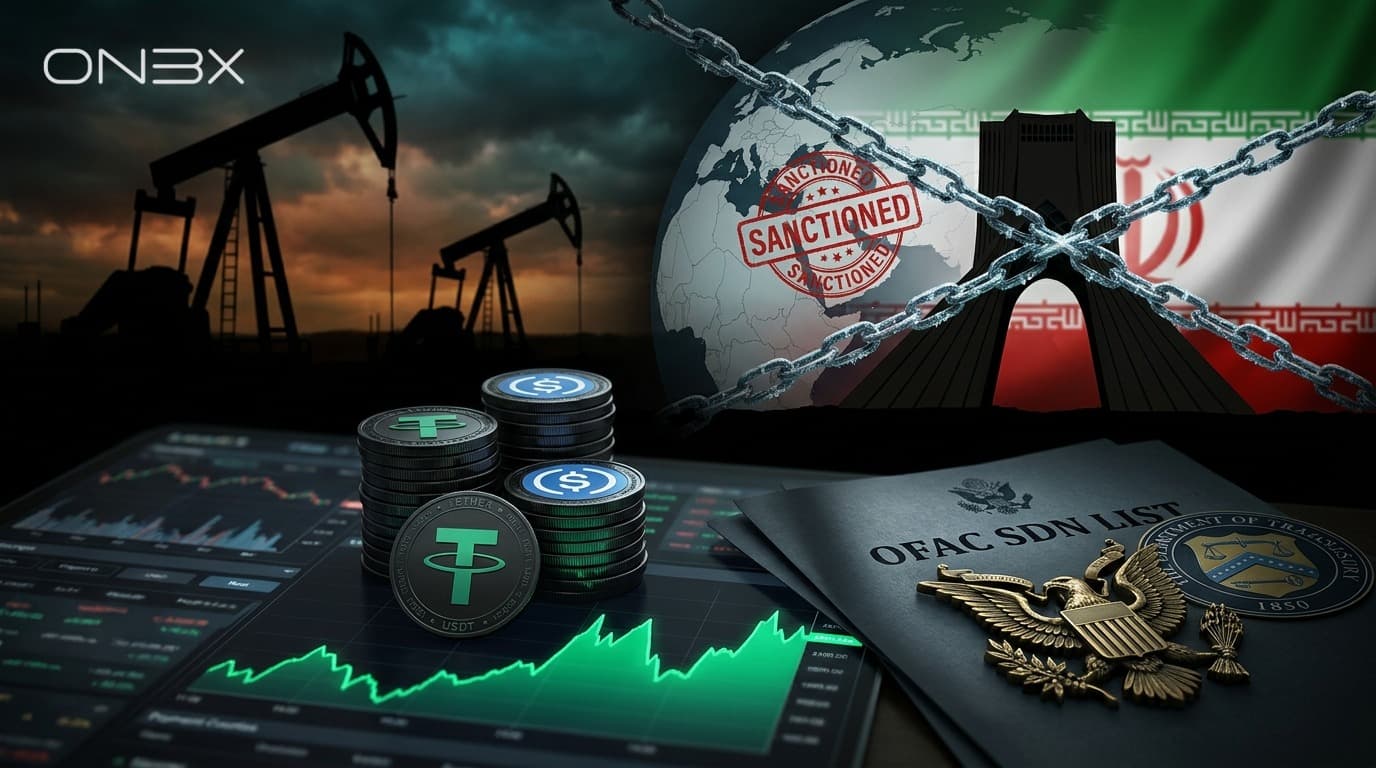
On Thursday, April 23, 2026, Tether pressed the button. In a single action coordinated with the Office of Foreign Assets Control (OFAC) of the U.S. Treasury and multiple U.S. law enforcement agencies, the world's largest stablecoin issuer froze US$ 344 million in USDT distributed across two wallets on the Tron blockchain. One wallet held US$ 212.9 million; the other, US$ 131.3 million.
It is the largest single USDT freeze of the year and one of the largest in history in a single transaction. On Friday, April 24, the U.S. Treasury confirmed that the operation is part of a sanctions campaign named "Economic Fury", aimed at choking off financial channels of the Iranian regime. The target was not a North Korean hacker or a fraud network. It was explicit geopolitics — and USDT became, in practice, the lever.
What this event makes explicit is what has always been in the contract, but is rarely discussed clearly: USDT is not decentralized money. It is an IOU issued by a private company that contractually maintains the right to freeze balances at any time, in any wallet, at the request of a competent authority. In 2026, this ceased to be a technical detail and became a central axis of American foreign policy.
The mechanics of the freeze
Technically, the freeze was simple. The USDT contract on Tron — as on the other 14 blockchains where the token circulates — has an administrative function called blacklist that can be invoked by the issuer. Once an address enters this list, any USDT it holds becomes permanently immobilized: the balance continues to appear in the wallet, but any transfer attempt reverts. The money turned into a statue.
The decision-making process involves three stages, according to public statements from Tether itself:
- Formal request from a recognized authority — in this case, OFAC plus unnamed federal agencies.
- Internal validation by Tether's compliance team, which correlates addresses, flow patterns, and evidence presented by the authority.
- Execution of the blacklist via a transaction signed by the contract administration, with immediate effect.
The average time between request and execution, according to previous public cases, is just hours in urgent situations. When the case involves OFAC sanctions, urgency is maximum: each additional hour allows capital to be moved to another blockchain or exchanged for another asset.
Why OFAC, and what is "Economic Fury"
"Economic Fury" is the official name of the multilateral sanctions campaign coordinated by the U.S. Treasury against Iran's financial infrastructure, announced as a response to the expansion of Iran's nuclear program and operations through regional proxies. The campaign targets three fronts: oil, traditional banking system, and — for the first time explicitly — crypto flows.
Iran, under sanctions for nearly two decades, has developed in recent years a robust crypto-parallel financial ecosystem. State-owned mining companies, domestic exchanges, and offshore OTC operations began using USDT as the preferred denomination for international settlement. The reason is technical: stablecoins on Tron have near-zero fees, settlement in seconds, and — until now — were perceived by the Iranian establishment as less subject to Western interference than the SWIFT banking system.
This last point, after April 23, stopped being true.
The immediate geopolitical parallel is with the Strait of Hormuz crisis we covered in March, and with the thesis of bitcoin as a refuge in sanctions environments. The difference is that bitcoin is truly censorship-resistant — it has no freeze button. USDT does not. And that difference — invisible in calm times — becomes glaring in moments like this.
The contract that no one read: the part that says "we can freeze"
Tether's Terms of Service are clear, and have been there for years. Translation of the relevant section: Tether reserves the right to block any USDT in any wallet, at any time, at the request of a competent authority or in case of suspected illegal use. There is no ambiguity. There is no gradation. There is no practical recourse.
Most USDT users — including in Brazil — operate under the perception that stablecoin is "digital dollar without borders". In 99.9% of practical cases, it is. But the 0.1% — operations that cross the radar of American authorities — immediately falls under the discretion of the issuer, which ultimately operates under jurisdiction that reports to the U.S. Treasury.
The parallel with the Arbitrum's decision to freeze US$ 71 million from the Kelp hacker is direct. Arbitrum also has a pause button; also used it; also faced debate about what that means for "decentralization". The difference is in magnitude: Arbitrum is a network; Tether is a US$ 145 billion rail in circulation. When Tether presses the button, it moves the entire economy.
The historical numbers: US$ 4.4 billion already blocked
The April 23 freeze is not an exception. It is accelerated continuity of a policy that Tether has been operationalizing for years with increasing transparency. The public numbers:
- Tether formally cooperated with more than 340 law enforcement agencies in 65 countries.
- This cooperation supported more than 2,300 investigative cases worldwide.
- The accumulated total of frozen USDT over the years exceeds US$ 4.4 billion.
- The pace of freezes accelerated in 2025-2026, partly due to regulatory pressure, partly because Tether has an incentive to demonstrate active compliance reputationally.
It is corporate public policy, executed with method. Freezes happen faster than many traditional bank freezes — because on-chain infrastructure makes immediate action technically viable, and because Tether does not have the procedural friction of banks with individual customers.
Implications for BR strategy
Brazil is today one of the largest USDT markets in the world by per capita volume. Brazilian companies use USDT to pay Chinese suppliers, OTC traders operate cross-border settlements, local fintechs offer dollar savings products based on USDT. The USDT vs USDC duel we covered in April already pointed out: USDT dominates volume, USDC gains where compliance matters more than liquidity.
After April 23, this calculation changes. The Brazilian executive who decides between USDT and USDC in the company's treasury needs to consider:
- Political counterparty risk. If your operation has any leg in Iran, Russia, Venezuela, or other sanctioned jurisdictions — even indirectly through a third-party supplier — USDT in relevant volumes becomes real risk, not theoretical.
- Over-blocking risk. In past cases, Tether froze addresses on suspicion that later proved unfounded, and unblocking took weeks. If the frozen capital is working capital, the operational impact is severe.
- Local regulatory pressure. Combined with the global stablecoin regulatory race and with USDC integration into Pix, the Brazilian Central Bank tends to look at the USDT ecosystem with more attention in 2026.
For DREX, the reading is different. Stablecoin issued by the Central Bank — sovereign, in digital real — becomes immune to this type of external discretion. The strategic argument for DREX, which seemed abstract in 2023, gained concrete illustration on April 23. It is not mere exercise of monetary sovereignty; it is geopolitical hedge.
The USDC opportunity and market bifurcation
There is an optimistic reading for Circle here — and it is being pursued aggressively by the company itself. USDC is, officially, "stablecoin regulated in the U.S. with institutional transparency". It has audited reserves, is registered with FinCEN, operates under the GENIUS Act. In theory, this means less probability of surprise freeze, because the criteria are more formalized.
In practice, USDC also has a pause button. Circle has frozen addresses before — including OFAC cases. But market perception is that Circle operates under more predictable criteria than Tether, whose freeze policy has a history of more aggressive discretionary decisions. For the conservative corporate treasurer, this becomes a decision factor.
The likely result over the next 12 months: market bifurcation. USDT continues to dominate retail, OTC, and jurisdictions where compliance is more flexible. USDC gains ground in regulated corporate, listed fintech, public company treasury. It is not zero-sum — the total stablecoin market grows — but relative participation changes.
The ON3X perspective
Three takeaways to close.
One: centralized stablecoin is a regulated rail, not decentralized money. Anyone using USDT or USDC with the expectation that the asset is censorship-resistant is operating with the wrong mental model. These assets are more convenient than the traditional banking system in many respects. They are not more sovereign. The difference is fundamental — and on April 23 it became public for anyone who hadn't understood it yet.
Two: bitcoin comes out strengthened, ironically. Every centralized stablecoin freeze reinforces bitcoin's original argument: digital money that no authority can immobilize. In 2026, with corporate treasuries like Strategy holding 815,000 BTC and ETFs moving billions, this argument gains practical relevance that it did not have when bitcoin was perceived as a speculative hobby asset.
Three: for the average Brazilian operating with crypto, the lesson is stablecoin diversification. Concentrating treasury in USDT is rational on the liquidity side, irrational on the risk side. The combination USDT + USDC + bitcoin (with proportions varying according to profile) reduces exposure to individual political freeze. It is not sophisticated portfolio management — it is basic hygiene in an environment where the preferred rail can stop functioning at any moment.
April 23 will be cited for years as the moment centralized stablecoin explicitly entered the U.S. geopolitical toolkit. The thesis has always been that. Now it is history.