

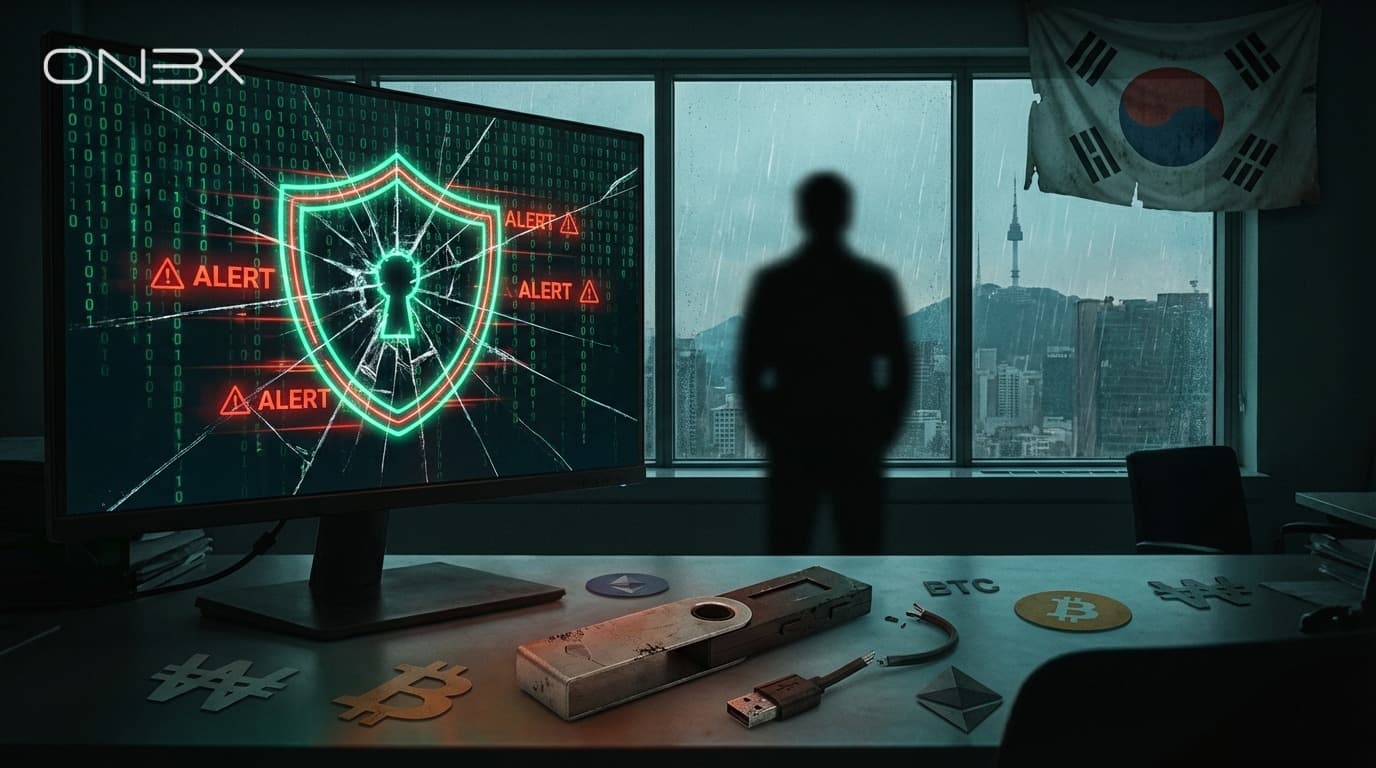
The Same Platform, the Same Type of Attack, Three Years Later
On April 9, 2026, in the early morning hours in Seoul, users of South Korean exchange GDAC woke up to a scenario that many thought they would never see again: their wallets frozen, withdrawals suspended and, hours later, official confirmation — the platform had been hacked for approximately $13 million, representing about 23% of total custodied assets.
The incident is more than a theft. It is the second major breach of the same exchange in three years, and reopens a debate that the Korean crypto market thought it had overcome: misconfigured hot wallets at second-tier exchanges remain an active vector, even in a market already considered among the most regulated in the world.
What Was Stolen
On-chain analysis identified the following assets transferred to an unidentified wallet:
- 60.80864074 BTC — approximately $4.3 million at the time's value
- 350.5 ETH — approximately $1.1 million
- 10,000,000 WEMIX — South Korean gaming token, heavily linked to Wemade
- 220,000 USDT — the most easily traceable portion
The pattern is classic: compromised hot wallet, funds drained in minutes, distribution across multiple addresses to hinder tracing.
GDAC's Immediate Response
The exchange responded with standard mitigation measures:
- Immediate suspension of deposits and withdrawals
- Announcement of "emergency server maintenance"
- Communication with authorities: Korean Police, KISA (Korea Internet & Security Agency), FIU (Financial Intelligence Unit)
- Public request to other exchanges and DeFi protocols to freeze the funds should they be sent to their platforms
The response is procedurally correct. What raises concern is the silence on the compensation plan.
The Sinister History: April 2023
GDAC had already been breached in April 2023, losing between $10 and $25 million in a similar hack. At that time:
- A formal compensation plan was never announced
- There was no insurance fund from the exchange
- There was no partnership with an asset recovery firm
- Users were effectively left to their own devices, with the platform operating in reduced mode while rebuilding its position
The repetition of the pattern in 2026 raises uncomfortable questions: did the exchange learn any lesson? Is there sufficient capital to cover 23% of lost assets? Or will users again absorb the loss?
The Bigger Context: South Korea as a High-Risk Market
South Korea is simultaneously one of the world's largest crypto markets and one of the most exposed to incidents. Some data points:
- About 6 million active crypto investors
- Daily volume frequently among the top 5 globally
- Strong presence of local tokens (WEMIX, KLAY, ICX) that don't list on major international exchanges
- Market historically attractive to North Korean groups, given geopolitical proximity and volume
While Upbit, Bithumb, Coinone and Korbit (the "Big 4") are relatively robust and have insurance funds, second-tier exchanges like GDAC operate with substantially inferior infrastructure — and become priority targets.
The WEMIX Question: The Elephant in the Room
Ten million WEMIX represents a significant portion of the token's circulating volume. The attacker's distribution of funds could:
- Dump on Upbit/Bithumb and crash the price, realizing quick profits
- Pressure Wemade (the issuer) into some mitigation mechanism (burn, buyback, etc.)
- Affect the WEMIX/Play-to-Earn ecosystem, whose recovery from the 2022 depeg has been fragile
If the attacker is linked to DPRK — a hypothesis not yet confirmed — coordinated liquidation may be part of the theft monetization strategy.
Attribution: North Koreans Again?
Preliminary analysis by firms like Elliptic and TRM Labs has not yet formally attributed the hack. But circumstantial indicators are suggestive:
- Target on Korean exchange (historical DPRK pattern)
- Speed of execution (early morning hours, low vigilance window)
- Mix of assets — includes WEMIX which has concentrated local liquidity
- Fund dispersal pattern consistent with typical Lazarus/UNC4736 cross-chain laundering
If confirmed, it would be another in the series of attacks on Korean infrastructure by North Korean state actors — who have already accumulated over $1.7 billion stolen from South Korea since 2017, according to official estimates.
Impact on the Local Market
Reactions were mixed:
Upbit, Bithumb, Coinone (Big 3)
The major exchanges issued statements reinforcing their own security practices (cold storage, multi-sig, insurance funds) and took the opportunity to attract worried users. Volumes on the Big 3 increased in the following days.
Regulators
South Korea's Financial Services Commission (FSC) promised a review of capital and security requirements for smaller exchanges. There is discussion of substantially raising the minimum capital requirement for operations.
Retail Investors
The South Korean crypto community — known for being highly active on social media — organized quickly. Campaigns on X, Telegram and KakaoTalk are pushing for clarity on compensation and transparency in the investigation.
What to Do If You Had Funds on GDAC
- Document immediately all balances and statements via screenshots and exports
- Await official communications on compensation or reopening, avoiding scams that impersonate the exchange
- File a complaint with FSS/FIU (Korean authorities) if you are a South Korean resident
- Consider consolidating future exposure on Big 3 exchanges with insurance funds and more robust regulation
- For remaining assets (if the platform reopens), consider self-custody via hardware wallet for long-term positions
Conclusion: The Long Tail of Crypto Security
While top-tier exchanges invest hundreds of millions in security and hire former CISOs from major banks, the base of the pyramid still operates with inadequate infrastructure. And it is precisely there that the largest share of users — beginners, price-shoppers, regional token traders — keep their funds.
The GDAC case is not unique nor particularly sophisticated. It is a brutal reminder that in 2026 crypto, exchange quality matters more than asset quality. A Bitcoin on a misconfigured exchange is riskier than an altcoin in institutional custody.
For Korean regulators, the path forward seems clear: raise the floor. For the user, the path is even simpler: not your keys, not your coins — and when you do custody on an exchange, choose one with an insurance fund, majority cold storage, and a history of surviving attacks.
Disclaimer: This content is informational and does not constitute investment advice. Do your own research before making financial decisions.