

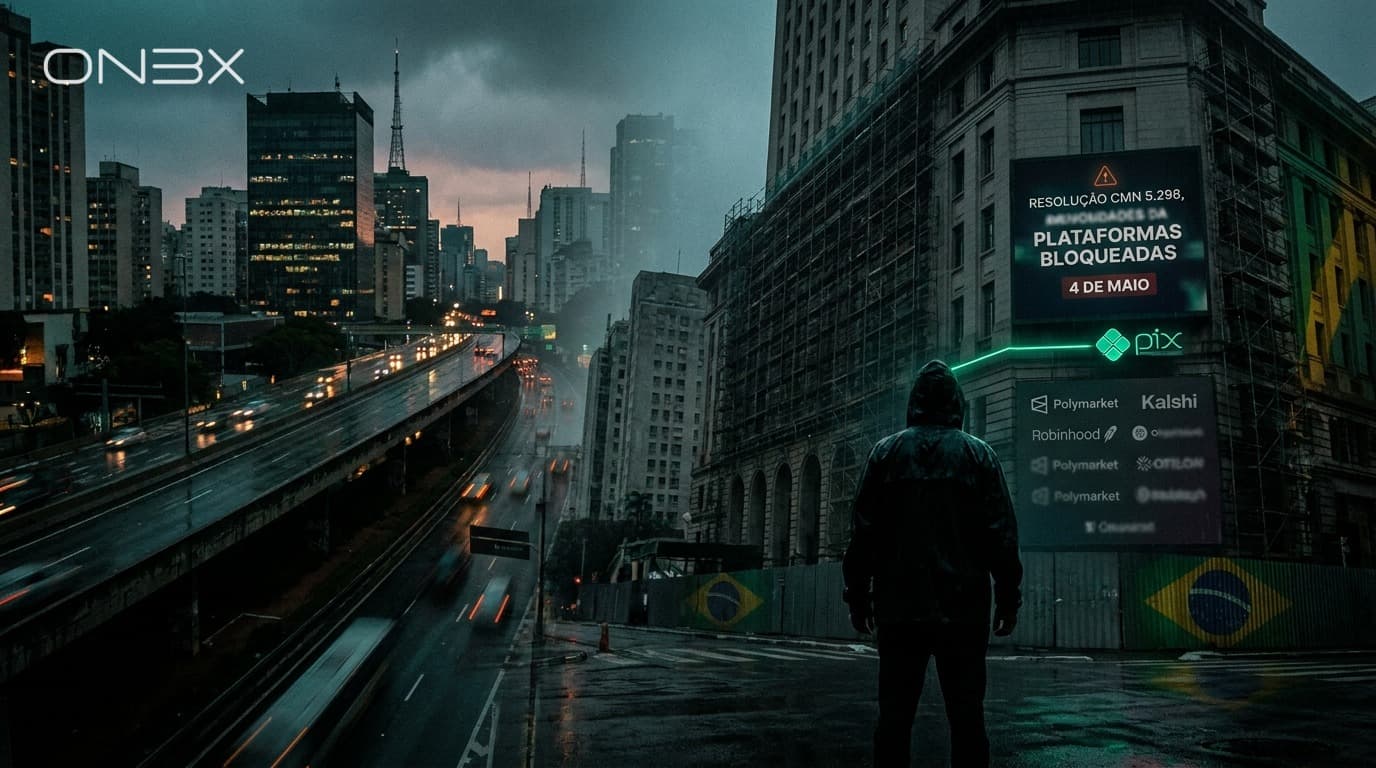
On the morning of Friday, April 24, 2026, the Brazilian trying to access Polymarket to check election market quotes began receiving the same response: site unavailable. It wasn't a bug. It was public policy. In just over 24 hours, Anatel notified approximately 19 thousand internet service providers in the country to simultaneously block 27 digital prediction market platforms — including Polymarket, Kalshi, Robinhood, IBKR ForecastTrader and PredictIt. Brazil ended, overnight, the largest category of decentralized financial products growing in the world.
The legal instrument that unlocked the operation is CMN Resolution No. 5,298, published on Thursday, April 23 and officialized on Friday in a joint statement by Finance Minister Dario Durigan, Chief of Staff Minister Miriam Belchior, Secretary for Economic Reforms Régis Dudena and Consumer Secretary Ricardo Morishita. The norm becomes effective on May 4, 2026 — exactly the same date when the mandatory exchange regime for cross-border crypto operations goes into effect. It's not a coincidence. It's the regulatory turning point of the year, on three simultaneous fronts.
CMN Resolution 5,298 deciphered
The text of the norm is surgical. Resolution 5,298 prohibits, on Brazilian territory, "the offering and trading of derivative contracts whose underlying assets are related to":
- Real sporting events (games, championships, individual athlete performance).
- Virtual online gaming events (esports, simulations).
- Political, electoral, social, cultural, entertainment events or any non-financial topic.
The key concept of the norm is "economic-financial substance". For the CMN, a derivative contract is only legitimate when the underlying asset is a measurable financial variable: interest rate, index, exchange rate, commodity, stock, security. Everything outside that list becomes gambling — and gambling in Brazil can only be offered by an operator licensed by the Prize and Gambling Secretariat (SPA/SECAP), within the scope of Law 14,790/2023 (sports betting and online casinos).
Durigan summarized the government's thesis in a sentence that will go into the record: "This looks, smells and tastes like gambling." The official legal interpretation is that prediction markets, when involving betting on events with binary outcomes (yes/no), are semantically identical to gambling — and attempting to frame it as a financial derivative is, in jargon, "regulatory arbitrage".
According to the resolution's own text, derivatives on "the Central Bank's decision on interest rates at next Tuesday's meeting" remain permitted. In other words: you can bet on the policy rate decision; you cannot bet on Big Brother.
The 27 platforms: the blocking map
Initially the government announced 28 platforms. Later it corrected to 27, removing a duplicate. The official list from the Finance Ministry includes:
Global players: Polymarket, Kalshi, Robinhood, IBKR ForecastTrader, PredictIt, Hedgehog Markets, Predict.fun, ProphetX, Novig, Fanatics Markets, OG Prediction Markets, Stride, PRED Exchange.
National or Portuguese-language players: MercadoPred, Cravei, Eu Já Sabia, Futuriza, Palpitada, Palpitano, Palpita, Pliks, PolySwipe, PRÉVIAS, Previsão, Ruckus Market, Véspera, Voxfi.
Two points stand out. First, the inclusion of Robinhood — which historically operates as a retail brokerage and not as a pure prediction market, but launched "event contracts" in 2024. Blocking Robinhood's main domain in Brazil is disproportionate to the resolution's scope and likely becomes a litigation point. Second, the heavy presence of Portuguese-language platforms with the appearance of local operations, such as Palpita, Palpitano and Palpitada — a sign that a Brazilian ecosystem was forming on its own, not just use of global platforms via VPN.
The blocking is executed via DNS at the provider level. It doesn't prevent use via VPN or via Web3 wallet connected directly to the contract (in the case of Polymarket, which operates on-chain). But it removes access to the product from the Brazilian retail layer.
Polymarket in Brazil: the US$ 57 million market
The numbers on what will disappear explain why the government acted now, not in January. Before the block, Polymarket's largest Brazil-related market was exactly the 2026 presidential election, with US$ 57.5 million (R$ 287.5 million) in open volume. On Kalshi, the same market moved US$ 1.1 million.
Pre-block quotes showed a picture that directly aligned with conventional polls — and sometimes anticipated them:
- Polymarket: Flávio Bolsonaro 39%, Lula 36%, Romeu Zema third.
- Kalshi: Flávio Bolsonaro 42%, Lula 38%.
It's hard to read these numbers in the electoral calendar without identifying the overlap with local political tension. Public prediction market in an election year becomes an alternative indicator that competes for attention with Datafolha and Quaest. For any government in power whose popularity is under pressure — the current situation — the existence of a 24/7 international tracker showing opposition favoritism is, at minimum, unwanted noise. The government's stated motivation is consumer protection. The unstated motivation, plausibly, also includes silencing an inconvenient political thermometer.
Why May 4? The regulatory convergence no one is discussing
Here's the detail that changes how you read this entire operation. The effective date of CMN Resolution 5,298 — May 4, 2026 — is exactly the same date when full obligation begins for the mandatory exchange regime for international crypto operations, within the package of Central Bank Resolutions 519/520/521.
It's not loose programming. It's deliberate convergence. By concentrating three regulatory fronts on a single date — cross-border crypto, prediction markets and the ongoing crackdown on illegal gambling (over 39 thousand domains blocked since 2024) — the government creates a symbolic turning point where Brazil's digital ecosystem stops operating in a gray zone. The message to the market is clear: the State intends to have full visibility of everything that crosses Brazil's border in the form of digital financial flows, whether in USDT, in prediction contracts or in gambling links.
For crypto companies, fintech, financial technology or any operation touching these three topics, May 4 becomes the equivalent of a regulatory activation date. Whoever isn't ready gets locked out — totally or partially — from the market.
The crypto layer: USDC, USDT and the contradiction the Central Bank will have to resolve
There's explicit crypto angle that few outlets are covering. Polymarket operates primarily in USDC — stablecoin issued by Circle — on Polygon. Kalshi settles in dollars via traditional banking. Other platforms on the list use USDT, USDC or smaller stablecoins.
The paradox the Central Bank will need to face in the coming weeks is this: the same institution that integrated USDC into Pix in April — signaling institutional acceptance of the stablecoin as a payment rail — now prohibits using that same stablecoin for what it considers "disguised derivative gambling". The line between permitted and prohibited use depends exclusively on the context of the operation, not the asset itself.
This echoes international discussion made explicit just two days earlier, when Tether froze US$ 344 million in USDT at OFAC's request. In both cases, the thesis is the same: stablecoin is a regulated rail, not decentralized money. What's permitted with USDC depends on who's looking, under which jurisdiction and for what purpose.
For the Brazilian Polymarket user, this means a concrete technical problem: open positions in election, sports or entertainment contracts remain accessible on-chain (Polygon cannot be erased by Brazilian decree), but the exit — converting USDC to BRL via regulated SPSAV — becomes a risky path. The link between the user's wallet and the prohibited platform can, in the most aggressive reading of the norm, turn the entire flow into an irregular operation.
Brazil vs. USA: Kalshi won at the CFTC, was banned in Brasília
The international contrast makes Brazil's position even more notable. In the United States, Kalshi won, throughout 2024 and 2025, a series of legal battles against the CFTC to establish itself as a regulated event contract exchange. Polymarket, after being prohibited in the US in 2022, has been operating in a gray zone with growing volume and open dialogue with state regulators. The American trend, despite friction, is toward regulation rather than banning.
Brazil chose the opposite path. And it's not just Brazil. Argentina had already blocked Polymarket on March 16, 2026, before Brazil's April turnaround. The regional Latin American pattern is becoming clear: preventive banning, not regulatory framework. It's a conscious policy decision. The authorities in both countries prefer to assume the cost of censorship rather than the cost of regulating a market they perceive as merely a sophisticated version of gambling.
It remains open what the European Union and United Kingdom's position will be in the coming months. MiCA, fully implemented in 2026, hasn't yet explicitly addressed prediction markets. Likely will in 2027.
What happens to open contracts and the average user
The most common practical question in the last 24 hours: what happens to the Brazilian who has an open position on Polymarket?
Technically, the position remains there. Polymarket is Polygon, and the smart contract keeps executing. The Brazilian block is DNS at the provider level — it doesn't affect the blockchain. The user can access via VPN, via another network, or via direct Web3 wallet.
Legally, that's where it gets murky. Maintaining an open position on the platform after May 4 can be interpreted, in the most aggressive reading of the Resolution, as participation in "irregular derivative operation". There's no jurisprudence yet. But the signal from authorities is clear: resolve before that date. Either liquidate the existing position or withdraw the balance (in USDC) to your own wallet, aware that the exit to BRL via regulated SPSAV will require strict documentary proof — exactly as per the crypto exchange regime we covered in detail.
The practical path: liquidate by May 3.
The ON3X perspective
Three readings to close.
One: Brazil chose speed over nuance. Resolution 5,298 was written, approved and published on a short timeline, without broad public consultation, without in-depth technical-legal debate on what conceptually separates financial derivative from event gambling. This can be justified by the consumer protection argument. But the side effect is that Brazil ends up out — or semi-out — of one of the fastest-growing financial product categories in the world. When, 18 or 24 months from now, the issue becomes agenda again, it will start from scratch.
Two: the May 4 convergence is the main story, not the 27 platforms. The focus on banning Polymarket and Kalshi is media-attractive. But the structurally important event is the regulatory package that takes effect on that date. Any company operating at any intersection between crypto, fintech, international payments, and non-traditional digital products needs to understand that Brazil's regulatory perimeter shifted phases on May 4, and continuing to operate as before won't be a viable option anymore.
Three: the thesis that "stablecoin is a regulated rail, not decentralized money" is confirmed. On April 23, Tether showed this by freezing US$ 344 million in USDT at OFAC's request. On April 24, Brazil's Central Bank showed the same thing from another angle: a derivative settled in USDC on Polygon is not, in practice, beyond Brazilian regulatory reach just because it's on-chain. The State finds capture points — exchange, ISP, conversion point to BRL — and acts. Anyone operating with the expectation that decentralized crypto infrastructure is a regulatory-free zone is, in 2026, working with outdated mental models.
What's worth monitoring in the coming weeks: whether Kalshi or Polymarket files suit against the Union to challenge the Resolution, and whether the Securities Commission (CVM) publishes additional interpretive guidance on what exactly separates "legitimate derivative" from "prohibited prediction contract". In both fronts, the definition will shape what is or isn't allowed in digital financial products in Brazil for the next five years.