

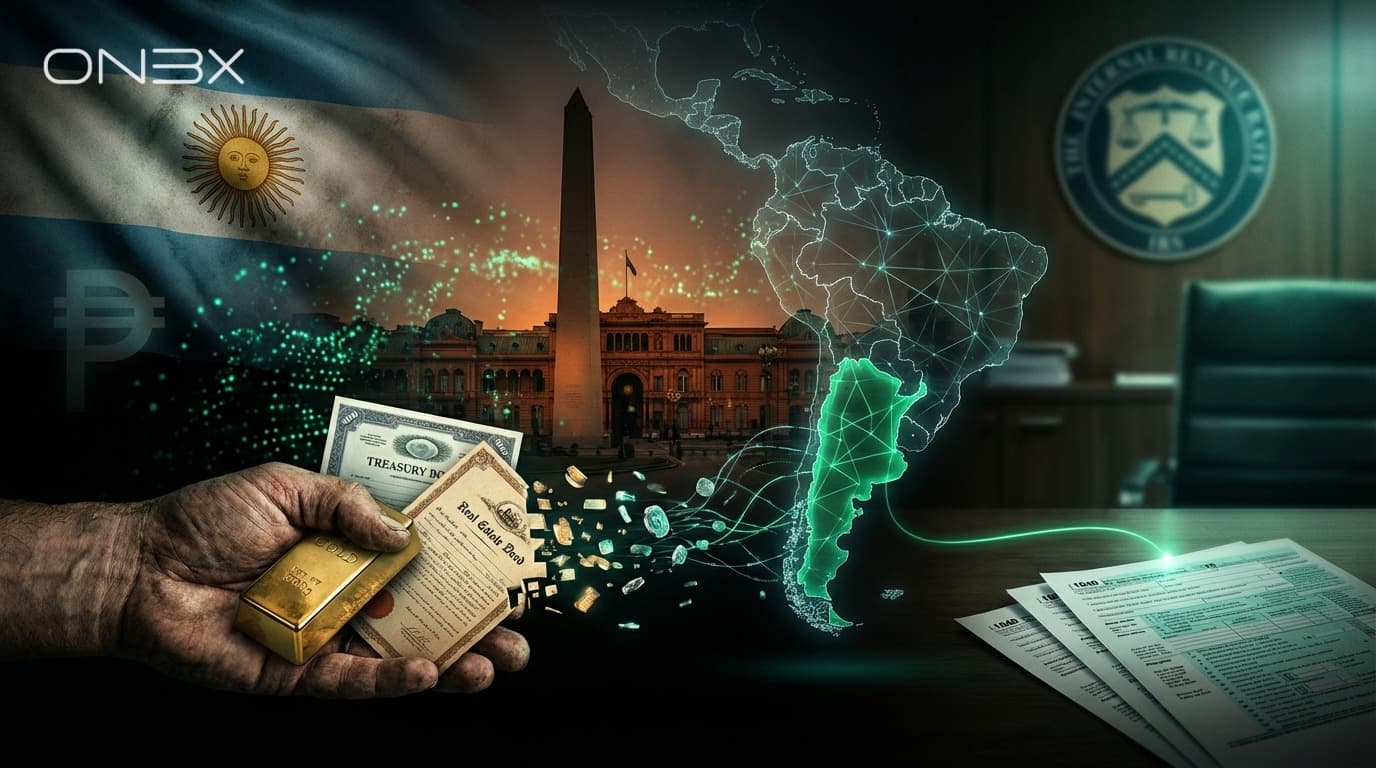
Argentina Takes the Lead in the RWA Game
Argentina's Comisión Nacional de Valores (CNV) approved General Resolution 1069/2026, establishing Latin America's first regulatory framework dedicated to Real World Asset tokenization (RWAs). The measure puts the country ahead of Brazil, Mexico, Chile, and Colombia in a segment that the global market projects will move over US$ 16 trillion by 2030.
The regulatory text is not philosophical — it is operational. It defines who can issue, what can be tokenized, how custody works, what rights the token represents, and how investors are protected. It is the first time in the region that a state regulator offers this level of clarity to a market previously operated in a gray zone.
What Resolution 1069 Allows
Public Financial Trusts on Blockchain
The initial pillar of the regulation allows public financial trusts — securitization structures widely used in Argentina to finance infrastructure, agriculture, and real estate — to be fully tokenized on blockchain.
This means that trust quotas, traditionally represented in paper titles or scripturally registered, can now be represented as transferable digital tokens, with:
- Secondary trading on authorized exchanges
- Instant settlement via smart contracts
- On-chain transparency of holdings and transfers
- Fractionalisation — quotas can be divided into smaller units, increasing accessibility
Included Asset Classes
The framework is designed to progressively accommodate:
- Agricultural commodities — soybeans, corn, wheat (strategic segment for the Argentine economy)
- Residential and commercial real estate — via real estate trusts
- Carbon credits — alignment with ESG agenda
- Business receivables — SMEs accessing working capital
- Public infrastructure — tolls, energy, sanitation
Issuance Rules
To issue RWAs under 1069, the entity must:
- Be a PSAV registered with the CNV (Virtual Asset Service Provider)
- Or operate as a registered fiduciary under traditional rules
- Comply with minimum capital, compliance, and asset segregation requirements
- Publish a regulatory white paper with mandatory information
- Obtain independent audit of the underlying asset
- Maintain liquidity reserves for redemptions in case of stress
How It Works in Practice
Scenario 1 — Real Estate Tokenization
A developer wants to finance a building in Puerto Madero. Instead of issuing traditional trust quotas:
- Registers a financial trust with the CNV
- Issues ERC-20 tokens (or equivalent) on authorized blockchain
- Investors purchase tokens starting from US$ 100 (fractionalisation)
- Tokens are tradeable on authorized exchanges (Ripio, Bitso, Lemon, future bank exchanges)
- Rental flows are distributed to holders via smart contract
Scenario 2 — Agricultural Commodities
A soybean producer wants to advance receivables from the next harvest:
- Registers a financial trust with receivables as collateral
- Tokens represent rights over a specific portion of future production
- Investors gain exposure to the Argentine harvest without needing complex futures contracts
- Settlement and delivery scheduled via smart contracts
Why Now: The Argentine Moment
Repressed Demand for Capital
Argentina faces chronic credit shortage. Sectors like construction, agribusiness, and SMEs operate with high spreads and restricted financing access. Tokenization offers direct path between issuer and capital, including foreign capital.
Leveraging Local Crypto Infrastructure
With 20% crypto adoption among Argentine adults and a robust ecosystem of exchanges and fintechs, the distribution of tokenized RWAs finds fertile ground. The same users who today buy USDT can tomorrow buy real estate trust tokens.
Regional Positioning
By establishing a framework before its neighbors, Argentina seeks to attract foreign issuers who want to tokenize regional assets. An American fund issuing tokens of Brazilian receivables could consider a structure under Argentine CNV with global distribution.
Milei Agenda
The measure aligns with the Milei government's libertarian vision of financial opening, global integration, and reduction of bureaucratic friction. Combined with Competition of Monies reforms (contracts in BTC/USDT), it creates a unique environment of crypto-fiat flexibility.
The Risks and Challenges
Technical Infrastructure
Tokenization requires reliable and auditable blockchains. Argentina must define:
- Which networks are considered adequate (permissioned L1? Ethereum L1? Public L2s?)
- Minimum technical standards (ERC-20, ERC-1400, ERC-3643 for security tokens)
- Integration with official registries (Property Registry, AFIP for taxes)
Institutional Adoption
Without banks, insurers, and pension funds participating, the market remains confined to the existing crypto retail base. The CNV signals work together with the Insurance Superintendency and ANSES to enable institutional participation.
Taxation
The AFIP still needs to publish specific guidance on taxation of gains, distributions, and transfers of tokenized RWAs. Tax uncertainty may inhibit adoption.
Investor Protection
Argentine investors — historically affected by the Bonex Plan, corralito, sovereign defaults — demand proof of real protection. The framework's credibility will depend on the first enforcement case: if fraud occurs in a tokenized RWA, will the CNV respond with the same vigor as it would with traditional securities?
The Global Picture: Argentina on the RWA Map
RWA tokenization is one of the hottest topics in the crypto industry. Macro numbers:
- BlackRock (BUIDL): tokenized T-Bills exceeded US$ 1 billion in 2025
- Franklin Templeton, WisdomTree, Ondo Finance operating in the segment
- Boston Consulting Group projection: US$ 16 trillion tokenized by 2030
- Singapore, Switzerland, Hong Kong, EU already operating with more or less mature frameworks
Argentina enters the map as the first South American country with a specific rule. It gains symbolic and regulatory advantage over its neighbors, especially Brazil (whose CVM has Resolution 88 but no such specific framework) and Mexico (Fintech Law without detailed tokenization).
What to Expect in the Next 12 Months
- Q2/2026: first pilot tokenized trust issuances, likely in real estate or receivables
- Q3/2026: participation of local exchanges (Ripio, Lemon, Bitso Argentina) as distributors
- Q4/2026: possible entry of Argentine banks via crypto units (cross-over with BCRA framework)
- 2027: cross-border issuances with international investors accessing Argentine assets
Conclusion: Tokenization as an Economic Policy Instrument
Resolution 1069 is more than regulatory update — it is an economic policy tool. By connecting local issuers hungry for capital to global investors via blockchain, Argentina tries to solve a decades-long structural problem: shortage of long-term credit for productive sectors.
If it works, the framework can inspire Brazil, Mexico, Chile, and others to follow suit. If it fails (via early fraud, anemic adoption, or technical inconsistencies), it becomes an argument against regional tokenization for years.
Either way, the move is significant. For the first time in decades, Argentina is in the uncommon position of being a pioneer in something in the financial sector. And the timing is good — the world is discovering tokenization, and whoever regulates first gains position.
Disclaimer: This content is informational and does not constitute investment advice. Do your own research before making financial decisions.