

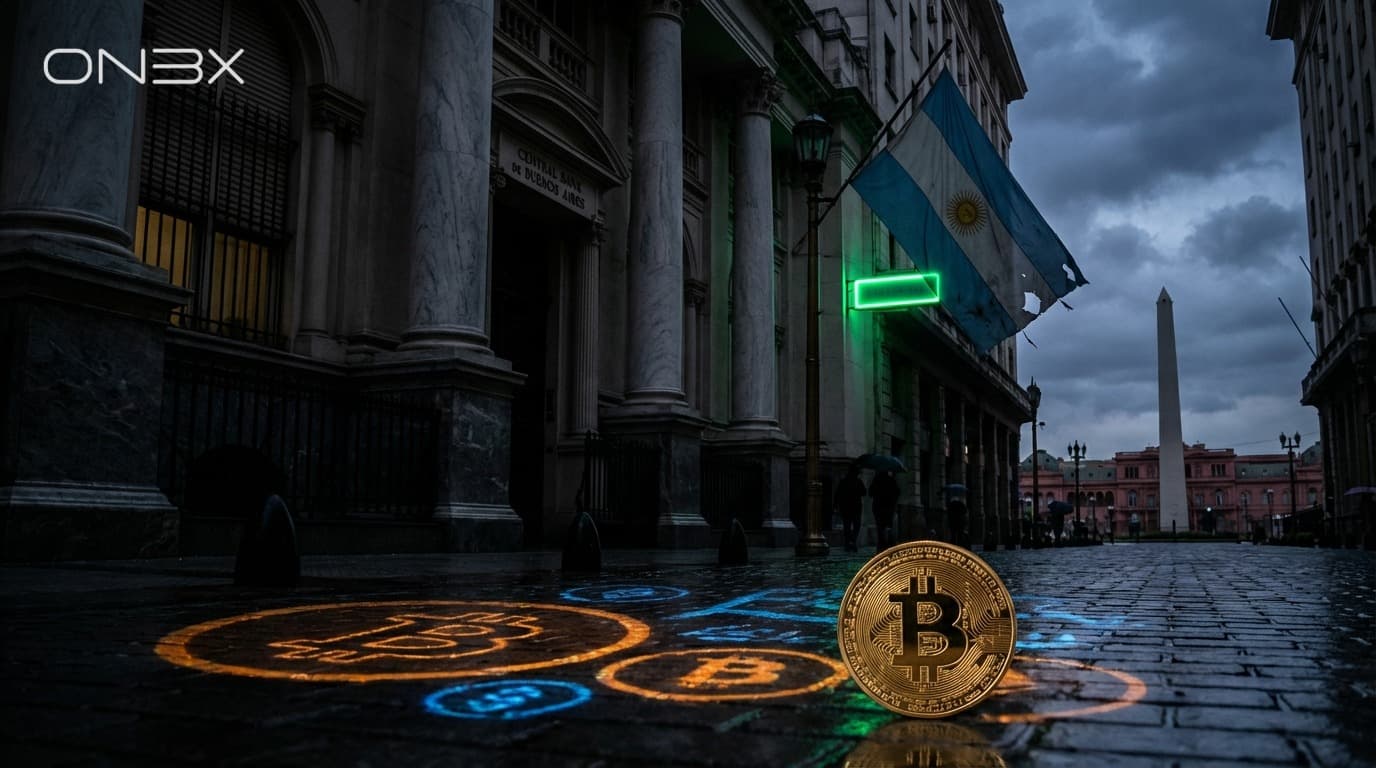
Argentina Turns the Page: Banks Will Operate Crypto in 2026
The Central Bank of the Argentine Republic (BCRA) is finalizing in April 2026 the regulatory framework that will allow, for the first time, Argentine banks to offer cryptocurrency services directly to their customers. The measure ends the ban imposed in 2022 and places the country at the forefront of integration between traditional financial system and digital assets in Latin America.
The framework is part of the Milei government's strategy to transform Argentina into a regional hub for crypto and fintech, leveraging exceptionally high domestic demand — the country has approximately 20% crypto adoption among the adult population, the highest in the region.
What the Framework Allows
Authorized Services
Under the new framework, Argentine banks will be able to integrate, via specific legal structures:
- Custody of Bitcoin and other selected cryptocurrencies
- Trading (buying/selling) within apps and mobile banking
- Swaps between pesos, dollars (stablecoins) and crypto
- Cross-border payments using stablecoins as rails
- Eventually, crypto-collateralized loans (later phase)
The Legal Architecture
To protect the traditional banking system, the framework requires that cryptocurrency services be offered by separate legal units (specialized subsidiaries), with:
- Enhanced capital requirements compared to regular banking activities
- Stricter cybersecurity and custody standards
- Additional liquidity reserves for volatile asset operations
- Full KYC/AML compliance supervised by CNV (National Securities Commission)
CNV + BCRA Regulatory Integration
The design leverages Law 27.739 (2024), which created Argentina's VASP (Virtual Asset Service Providers) framework, combined with CNV's General Resolution 1058/2025, in effect since December 31, 2025. The division is as follows:
- CNV: regulates and supervises PSAVs/VASPs (including bank subsidiaries)
- BCRA: supervises consolidated bank exposure and integration with the payment system
Why Now?
Three forces converge to explain the timing:
1. Pent-Up Demand
With inflation still around 33% per year and a history of aggressive capital controls, Argentines have digitally dollarized themselves via stablecoins. USDT represents 50% of all crypto volume in the country via Bitso; USDC accounts for another 22%. Stablecoins are used for:
- Payment of remote workers' salaries
- Rent and contracts (now legally possible in USDT/BTC via currency competition reform)
- Emergency savings
- International remittances
2. Competitive Pressure
Fintechs like Lemon, Buenbit, Ripio and Belo have captured a significant share of younger customers in recent years. Without crypto offerings, traditional banks saw themselves losing deposits and engagement.
3. Government Strategy
The Milei government positions crypto liberalization as part of the "currency competition" agenda — breaking the Argentine peso's monopoly as a unit of account. Allowing banks to operate crypto reinforces this narrative and brings foreign capital.
Who Wins
Large Banks
Santander Argentina, Galicia, Banco Macro and BBVA have already signaled interest. They have the capital to meet requirements and customer base to capture volume quickly. Significant pioneer advantage.
Local Exchanges
Counterintuitively, can benefit. If banks become "gateway providers", exchanges gain scale in on-chain activity, staking, DeFi and advanced services that banks won't offer.
Users
The big winners. Less friction (crypto in the same app as salary), greater perceived security (bank custody) and potentially lower fees due to scale.
Who Loses
- Smaller exchanges and informal P2P: lose retail volume that migrates to banks
- Crypto purists / self-custody advocates: see more centralization and censorship points
- Argentine offshore banking: part of demand for accounts in Uruguay/USA may return to the country
What Still Needs to Be Defined
Some questions remain open in the final framework:
- Which cryptocurrencies will be authorized (likely starts with BTC + major stablecoins)
- Whether there will be individual client exposure limits
- Specific tax treatment of bank crypto operations
- Interoperability rules with external exchanges (ability to withdraw crypto for self-custody)
Regional Context: Argentina as a Reference
The measure puts Argentina ahead of:
- Brazil: still discussing timid pilots with banks; BC regulation focused on exchanges (PSAVs)
- Mexico: Fintech Law restricts banks from directly operating crypto
- Colombia: limited sandbox, no massive bank integration
- Chile: debate still in early stages
Only El Salvador, for obvious reasons, is further ahead — but with an incomparable banking structure. Argentina becomes the largest Latin American market with native crypto banks.
Conclusion: End of Regulatory Limbo
Argentina spent years in a strange limbo: high popular crypto adoption coexisting with banking prohibition and regulatory gray zones. The BCRA framework closes that cycle. For users, it's more convenience and security. For banks, it's an opportunity to recover relevance. For the crypto ecosystem, it's another powerful signal that integration with the traditional financial system is irreversible.
The challenge now is execution: implementing the framework without creating excessive barriers, maintaining the pace of innovation and preventing institutionalization from stifling what makes Argentina a unique market — the average user's ability to use crypto as a practical everyday tool.
Disclaimer: This content is informational and does not constitute investment advice. Do your own research before making financial decisions.