

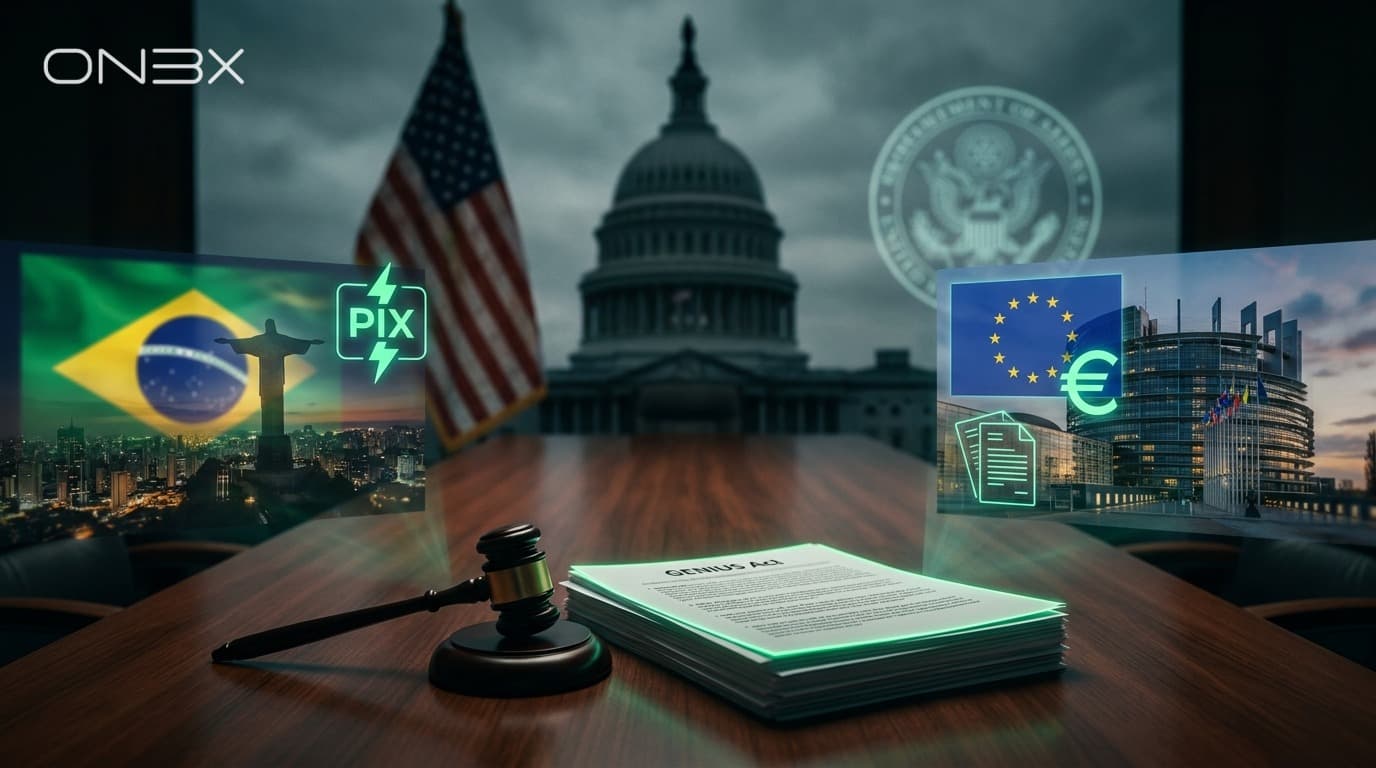
On April 22, 2026, the American Bankers Association and the Bank Policy Institute — the two largest banking sector associations in the United States — sent a joint letter to the U.S. Treasury, the Federal Deposit Insurance Corporation (FDIC), the Financial Crimes Enforcement Network (FinCEN), and the Office of Foreign Assets Control (OFAC) requesting more time. Sixty additional days, to be exact, on top of three regulatory proposals implementing the GENIUS Act, the federal stablecoin law signed by Donald Trump on July 18, 2025.
The banks' justification lies in a key paragraph of the letter: "Our comments will necessarily be more comprehensive, and therefore more useful to the agencies, if we have sufficient time to evaluate the proposed rules jointly and assess each one against the OCC's final framework." In short: there are too many rules, from too many agencies, all at once, and the sector needs to breathe.
The request is not absurd — it is, in fact, technically defensible. But it is symptomatic. While the American market still debates public comment deadlines, the European Union has already been operating under MiCA for over a year, and Brazil has set May 4, 2026 as the date when mandatory reporting of foreign exchange operations involving crypto becomes compulsory for any VASP wishing to continue serving Brazilian clients.
Whoever leads global stablecoin regulation in 2026 is no longer the entity that invented the stablecoin. And that has very concrete consequences for users, companies, and the digital dollar itself.
What is the GENIUS Act — and why it matters
The Guiding and Establishing National Innovation for U.S. Stablecoins Act (GENIUS Act) was signed in July 2025 with robust bipartisan support in the U.S. Congress. It is, in essence, the first federal law in the United States to recognize, define, and regulate payment stablecoins — those pegged to the dollar and used as a medium of exchange at scale.
The law prohibits, once it is fully in force, any entity from issuing a payment stablecoin in the U.S. without authorization as a Permitted Payment Stablecoin Issuer. Three categories can qualify:
- National banks and federal savings associations under supervision of the OCC (Office of the Comptroller of the Currency);
- State-chartered institutions operating under federal passporting regime;
- Non-bank entities specifically authorized as qualified federal issuers.
The detailed framework is being written now, in 2026, through a series of notices of proposed rulemaking (NPRs) from the OCC, Treasury, FDIC, and Federal Reserve. When finalized, it will be codified as 12 CFR 15 — an entirely new section of the Code of Federal Regulations dedicated to stablecoins.
The points covered are broad: reserve requirements, redemption standards, risk management, auditing, custody, minimum capital, operational backstops, and transition rules for issuers currently regulated only at the state level (such as the New York Department of Financial Services, which oversees Paxos and Gemini).
The legal deadline — and the real timeline
According to the letter of the law, the GENIUS Act takes effect whichever comes first: 18 months after enactment (i.e., January 18, 2027) or 120 days after federal primary regulators publish final rules. It is an ingenious mechanism — technically it forces regulators to move quickly, because if they don't publish rules before October 2026, the law takes effect without detailed regulation. In practice, the mechanism stalls when the regulated entities request extension after extension.
Why the banks want to delay
The ABA and BPI letter is not asking for the GENIUS Act to be revoked or diluted — it is asking for coordination. The central argument is quite technical: the three rules whose comment period the banks want extended are directly contingent on the OCC's final framework. And the OCC framework, in turn, is still being developed.
The obvious analogy is trying to comment on a house's finishes while the architects are still debating the blueprints. Technical comments made without seeing the parent rule tend to be incomplete, and incomplete comments generate poorly-formed rules. The sector prefers to see the full picture before opining.
There is a second, equally valid reading: American banks, traditionally skeptical of crypto, now see in the GENIUS Act a commercial opportunity. If stablecoins become a federally-regulated banking product, the entities leading the segment are those that already have deposit licenses. The more time they have to design the rules, the better the chance of consolidating position before crypto-native companies can adapt.
In other words, the delay request is simultaneously a technically legitimate action and a competitive move. Both readings are correct.
Meanwhile in the European Union: MiCA is already reality
The Markets in Crypto-Assets Regulation (MiCA) came into force on December 30, 2024, for stablecoins (called "ARTs" and "EMTs" in European terminology) and on December 30, 2024, for other crypto-asset service providers. In 2026, the regime is operational more than a year in, with licenses issued throughout the European Union under a unified passporting regime.
The practical effect: a stablecoin issued in Europe must have 1:1 reserves in high-quality liquid assets, segregated, audited monthly, with guaranteed par redemption rights enshrined in law. Issuers of significant EMTs — a category that essentially captures any stablecoin used at scale in the EU — face additional requirements, including volume caps for non-euro-denominated stablecoins.
It is precisely this cap that effectively banned USDT from licensed European exchanges over 2025 and 2026, forcing Circle (USDC) and local European issuers like Societe Generale-Forge to occupy that space. The market adjusted — not without pain, but it adjusted — in 18 months.
While the U.S. Treasury still collects comments, the EU already has real cases, compliance data, audit reports, and even enforcement precedents. ON3X, for example, operates under European VASP regime and has already delivered more than one complete audit cycle under post-MiCA requirements.
Meanwhile in Brazil: BCB races against its own timeline
In February 2026, the Central Bank of Brazil enacted Resolutions 519, 520, and 521, a complete regulatory framework for Virtual Asset Service Providers (PSAVs). The framework is dense, and compliance requirements come in waves:
- February 2, 2026: enactment of the general framework, mandatory BCB authorization to operate as a PSAV;
- May 4, 2026: entry into force of mandatory reporting for foreign exchange operations involving crypto — and, here is the game-changing point, stablecoins pegged to foreign currencies (USDT, USDC, EURC) are now legally treated as foreign exchange operations in Brazil;
- November 2026: end of grace period — unauthorized companies must cease operations.
The classification of stablecoins as foreign exchange is arguably the most consequential regulatory decision of the year in Brazil. Buying USDT on P2P is no longer equivalent to transferring a digital asset — it is, for all legal purposes, a commercial foreign exchange operation, subject to limits, reporting, and compliance with Brazilian foreign exchange regulation. International transfers of stablecoins via unauthorized platforms are limited to US$ 100,000 per transaction.
The BCB is not reinventing the wheel. It is, in fact, applying to stablecoins the same reasoning from the classical foreign exchange framework — if an asset performs the economic work of a foreign currency, it is treated as foreign currency. It is a consistent, predictable decision that gives the sector a clear 9-month horizon to adapt before enforcement begins.
Why this changes the Brazilian market
Brazil was already, before 2026, the largest stablecoin market in Latin America. The reasons are structural: intermittent inflation, real volatility, regional unbanked populations, culture of informal dollarization. USDT and USDC became the accessible "dollar savings" for millions of Brazilians — especially in classes C and D, where a traditional brokerage account remains a real barrier.
With Resolutions 519/520/521, that flow does not disappear. It is formalized. ON3X, which already operates as an authorized PSAV, gains competitive advantage over unlicensed platforms — integration with PIX, automatic reporting to the BCB, real-time conversion between BRL and USDC, all of this becomes the new regulatory minimum. No longer a differentiator, a requirement.
The structural irony: the inventor lost prominence
The United States produced 95% of the total value of stablecoins in circulation worldwide. Tether (USDT), Circle (USDC), PayPal (PYUSD), Ripple (RLUSD): all are American companies or of American parent. And yet, whoever effectively regulates this asset in 2026 is not Washington — it is Brussels and Brasília.
This is the central irony of the current moment. The country that led technical innovation fell behind in regulation. Tether spent years sheltering in jurisdictions like El Salvador and the Bahamas because the SEC and U.S. Treasury literally had no regime to receive them. Circle had to set up an Irish subsidiary under MiCA license to not lose access to the European market. PayPal had to launch PYUSD under the New York Trust Charter because there was no federal framework that could accommodate it.
When the GENIUS Act finally came into force in 2025, the market had already adapted — largely outside the U.S. American issuers will now have to return to the American federal regime, an operation requiring adjustments to corporate structure, custody, and compliance. The banks' delay in responding to the NPRs simply extends this limbo.
What this means for the end user
For the Brazilian using USDT daily, the message is direct: from May 4 onwards, the platform you use must be authorized by the BCB or you are technically operating outside the legal regime. This does not mean immediate risk for those using foreign exchanges in small volumes, but it means growing risk as the BCB implements enforcement tools — and will also mean more evident restrictions in larger volumes.
For those using stablecoins as a store of value, Brazilian regulation brings a real layer of protection: authorized PSAVs must segregate client assets, maintain reserves, audit, report. What was once blind trust in the exchange becomes, legally, a set of enforceable obligations. For anyone who remembers the collapses of Celsius, FTX, or Voyager, it is a structural gain.
For those using stablecoins for international remittance — Brazilians sending money to family abroad, or receiving payments from foreign employers — the change is more concrete: the operation now must be reported as foreign exchange, subject to limits and controls. The informal stablecoin market, which grew at the margins of regulation throughout the 2020s, has a deadline to adjust.
The ON3X position
ON3X operates as a VASP regulated in the European Union and as a PSAV in Brazil. This dual compliance is not a marketing label — it is, particularly in 2026, a real operational advantage. It means that the user depositing USDC on the platform is not betting on the regulatory robustness of a fragile jurisdiction; they are using infrastructure that meets the two most mature regimes of the moment.
While the American market still debates which agencies coordinate which rules, ON3X already delivers real-time PIX integration, instantaneous BRL/USDC conversion, segregated custody, and audited proof of reserves. The Brazilian and European regulatory framework is not an obstacle for ON3X — it is the minimum level on which the platform operates from day one.
The structural bet is clear: in two or three years, when the GENIUS Act finally comes into full force in the U.S. and the American market begins to adjust, Brazil and the EU will have already accumulated three years of operation under effective regulation. And companies born within this regime — not adapted to it — will be ahead.
Structural lessons
The first lesson from the story of the last twelve months is that technical innovation does not guarantee regulatory leadership. The U.S. invented nearly all relevant stablecoins in the world and yet is regulating six years after Brazil and a year after the EU. There is a cost to this — a cost borne by the end user, the issuer, the entire ecosystem.
The second lesson is that regulatory complexity is not synonymous with rigor. The American banks' request for an additional 60 days is not malicious — it is a natural consequence of a design where multiple agencies must coordinate NPRs simultaneously. MiCA and Resolutions 519/520/521 are, in comparison, simpler — one agency, one framework, one deadline. And they worked.
The third lesson, the most important for anyone planning a crypto product in 2026, is that operating in a regulated jurisdiction creates optionality. A stablecoin authorized by the BCB can run in Brazil without fear. A stablecoin with MiCA license can run throughout the EU. A stablecoin with nothing waits for Washington to sort itself out — and hopes the final regime is favorable when it finally arrives.
The story of the last twelve months should have made one thing clear: the shortest path to global legitimacy in the crypto sector no longer goes through the United States. It goes through Brussels and Brasília. And the American banks have just delivered, with the best of technical intentions, more proof of that.