

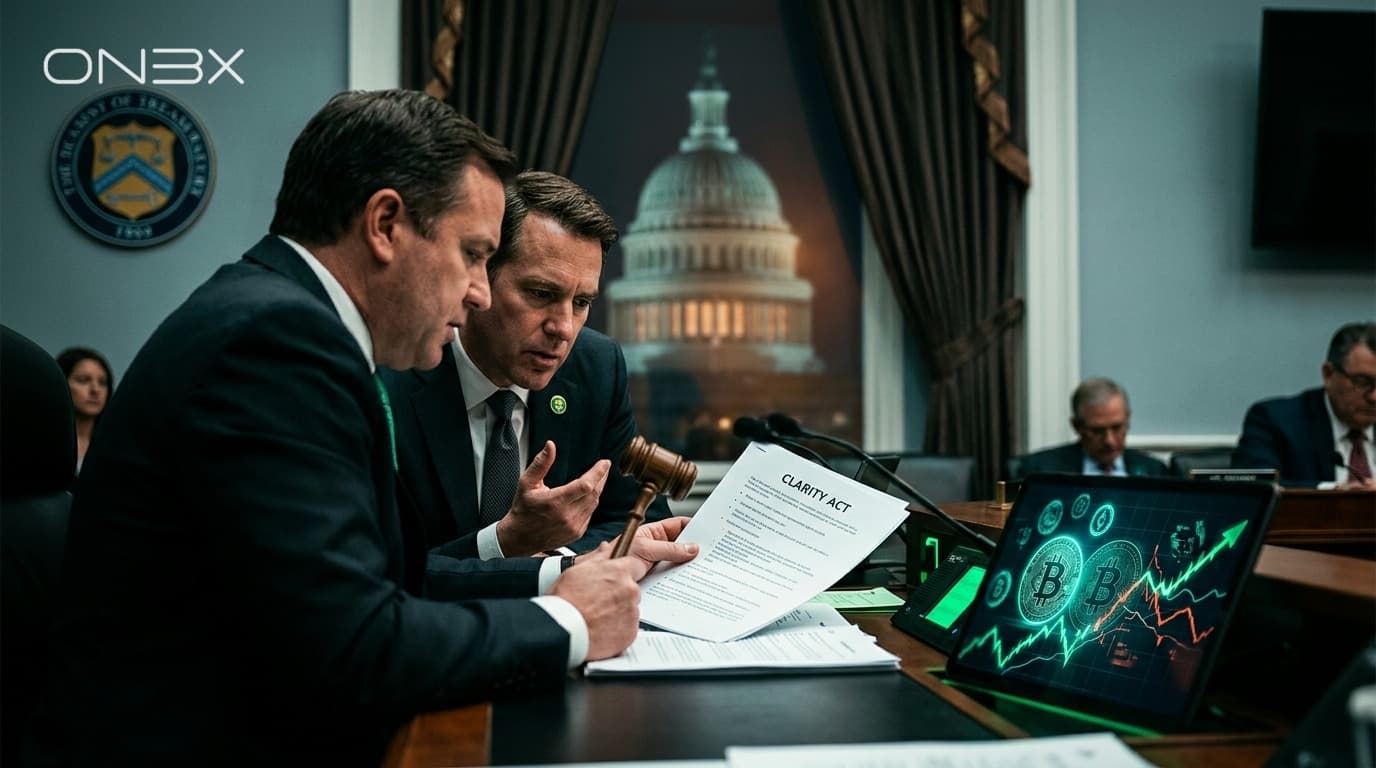
On May 14, at 10:30 a.m. Eastern Time in Washington, Senator Tim Scott, chairman of the Senate Banking Committee, will gavel open the Dirksen hearing room for markup of the Digital Asset Market Clarity Act. The bill was reformatted on May 1 by the Tillis-Alsobrooks deal that appeared to have unlocked the 18-month impasse over stablecoin yield. Three days before the vote, however, the ground has shifted — and no one in D.C. is pretending it shifted slightly.
On May 9, the three largest banking trade associations in the United States — American Bankers Association (ABA), Bank Policy Institute (BPI), and Independent Community Bankers of America (ICBA) — formally rejected the Tillis-Alsobrooks compromise. On May 11, three days before markup, the ABA escalated: it called on member banks and staff to contact senators individually to tighten language prohibiting stablecoin yield. This is no longer backroom lobbying — it is institutional mass mobilization in the final week before the vote.
The number being written into ABA memos for internal distribution is $2 trillion. The lobby's reading: if the yield loophole disguised as "activity-based reward" survives, the stablecoin market climbs from the current $321 billion to a range between $1 and $2 trillion in 24-36 months — draining bank deposits at a scale sufficient to reopen funding tensions for community banks and mid-sized banks. At Federal Reserve tables, nobody bought the thesis explicitly; at ABA tables, it is the briefing's centerline.
What ABA, BPI, and ICBA Are Asking for at the Last Hour
The three letters distributed on May 9 share the core but differ in tone. The ABA, more political, described the Tillis-Alsobrooks text as "incomplete" and asked for reopening the paragraph defining "activity-based reward". The BPI, representing large banks (JPMorgan, Citi, Bank of America), was technical: it requested an explicit list of what constitutes "activity" — otherwise, any trivial user action (login, click, navigation) becomes a hook for reward. The ICBA, the community banking group, was most pointed: it asked for complete elimination of any compensation mechanism, even if tied to real activity.
The split matters because it reveals what the lobby will accept. The ABA can be convinced to accept reward for payments completion (because banks themselves have similar products via card cashback). The BPI wants specific enumeration, in a typically banking registry where "incidental utility" cannot disguise yield. The ICBA wants no concession — it knows that community banks lose any direct comparison with Coinbase or Circle product, and prefers killing the product entirely to competing.
What this means for the markup: Tillis and Alsobrooks must renegotiate reward language before or during markup, or count on enough committee votes to approve current text without concession. Senate Banking has 24 members — 13 Republicans and 11 Democrats. The Republican caucus traditionally aligned with community banks (Senators Daines, Kennedy, Hagerty) is the pivot. If any of these three flags against current text, Tillis loses simple majority on the committee.
The Reinterpretation of "Activity-Based Reward"
The critical paragraph of the bill, in the May 1 updated version, defines that stablecoin issuers may offer rewards "tied to specific user activity, including completed payments, transfers, participation in platform programs, governance activity, and ecosystem utility". The language is deliberately broad — exactly what ABA and BPI attack.
Practical translation: Coinbase can run Coinbase Rewards (yield on USDC for active users), Circle can offer rewards for Circle Mint users, Robinhood can pay stablecoin yield to customers executing minimum monthly volume. All three programs exist today — they operate in regulatory gray zone. CLARITY would consolidate permission.
The banking lobby's argument is not technically wrong: in practice, the user does not distinguish between "yield" and "reward". If the product delivers 4.5% annually regardless of what the user does, it is yield under another name. The defense of legislators — and crypto lobbyists who drafted the language — is that "activity" requires operational friction: the user must execute, not merely hold a balance. The difference is legal but, at the consumer level, hard to feel.
The Senate Banking Committee Markup on May 14 will be the stage where this language is tightened or loosened through amendments. The markup, worth noting, is not a final vote — it is the stage where the committee can accept the bill as is, modify, or reject before sending to the Senate floor. The bill, if approved in markup, still needs to pass floor vote in the Senate (date not yet scheduled, expectation before July recess) and then reconciliation with the House version (H.R. 3633, approved in June 2025).
What CLARITY Does, in Concrete Terms
For those not following the bill's trajectory, here is the skeleton. The Digital Asset Market Clarity Act divides the crypto universe into three regulatory categories:
- Digital commodities — decentralized assets enough to fail the Howey test for securities. Include Bitcoin, Ethereum, and per the SEC and CFTC list of 16 assets, Solana, Litecoin, XRP, ADA, and more. CFTC jurisdiction over derivatives and fraud enforcement on spot.
- Investment contract assets — tokens still satisfying Howey by virtue of early-stage status, clear promoter expectations, or operational centralization. SEC jurisdiction, with ability to "graduate" to digital commodity once sufficient decentralization is reached.
- Permitted payment stablecoins — regulated under the GENIUS Act separately; CLARITY merely integrates the category into the framework and defines interaction between issuers and exchanges.
The three-class taxonomy is not new — the official five-class taxonomy from SEC-CFTC published in February 2026 had already paved the conceptual ground. CLARITY transforms that taxonomy into binding statute. The critical point, after class definition, is the DeFi safe harbor: the bill exempts activities related to operation and maintenance of blockchain networks from SEC jurisdiction, maintaining only anti-fraud and anti-manipulation authority. This is what validators, L2 sequencers, relayer operators, and non-custodial developers need to exit the gray zone where the Gensler era placed them.
The bill also establishes a 360-day timeline after presidential signature for SEC and CFTC to promulgate implementation rules. If signature occurs in July 2026 (baseline scenario if markup passes on the 14th), the framework is complete by mid-2027 — exactly when the OCC's Final Rule on GENIUS Act implementation also takes effect.
The Whip Count and What Polymarket Is Saying
Polymarket prices at ~75% the probability of CLARITY being signed into law in 2026. This is not the markup number — it is the complete scenario (markup + floor + reconciliation with House + President signature). The pricing reflects confidence in the institutional path, not comfort with each stage.
At the level of the May 14 markup, the calculation is more granular. Of the 24 Senate Banking members, the 13 Republicans vote as a bloc in ~70% of crypto-related cases, with predictable defection from Daines (community bank pressure), Kennedy (state licensing federalism), and occasionally Hagerty (banking compliance). Of the 11 Democrats, the split is more uncertain — Alsobrooks pulls the moderate wing, Warren and Reed pull to tighten, and the rest are in flux.
If current language (Tillis-Alsobrooks version) enters markup without amendment, the baseline scenario is 14-10 or 13-11 approval. If it enters with ABA-friendly amendment tightening reward, the scenario could reach 18-6 — but at cost of losing crypto lobby support, which could complicate the floor vote after. Tillis is walking a narrow line: cede enough to keep the committee united, without ceding so much that the bill loses support from the sector it nominally protects.
The Contrast with BlackRock's Comment Letter
The banking lobby's play must be read in parallel with what is happening across the street at the OCC. The 17-page comment letter from BlackRock, filed at the deadline of the OCC's NPRM comment period, attacks the 20% ceiling on tokenized reserves and asks for expanded eligible asset list. It is the same underlying fight: the ABA argues stablecoin cannot offer yield because it drains bank deposits; BlackRock argues stablecoin reserve can be 100% tokenized Treasury (and therefore dispenses with the custodian bank).
Both moves attack the same pillar: banking control over the American monetary base. The difference is the battlefield. CLARITY defines whether the end-product (stablecoin with yield) is permitted; OCC NPRM defines whether the back-end reserve (tokenized Treasury instead of cash in deposit) is permitted. If both moves win in parallel, the banking model of the past 80 years loses structural traction in the next decade.
This is why the ABA's mobilization this week is out of the usual tone. The American banking lobby is not agitating against "crypto"; it is agitating against the complete architecture of the tokenized dollar that CLARITY + GENIUS + OCC-NPRM, together, would enable.
The Global Asymmetry and What Brazil Has to Do with It
Meanwhile, across the Atlantic, Christine Lagarde endorsed in Madrid the ECB's tightening on dollar stablecoins via Resolution 561 and described expansion of USDT/USDC as "threat to European monetary sovereignty". Brazil has already made its choice: it sided with Europe, with Resolution 561 prohibiting dollar stablecoins in eFX, Resolution 521 bringing self-custodial wallets into FX oversight, and strangulation of private tokenized real in Bill 4.308.
The operational consequence for Brazilian capital is direct. If CLARITY passes the May 14 markup and proceeds to floor, and if the OCC absorbs BlackRock's recommendations — two events with reasonable joint probability through Q1 2027 — the supply of tokenized American dollar instruments becomes the best-liquidity, best-reserve, and best-compliance option on the planet. Brazilian investor capital (agro, infrastructure, real estate) that today pre-allocates dollars via XAUT, BUIDL, or USYC on the offshore side will have, in 2027, a much richer and regulated menu on the other side of the border — exactly when the Brazilian regime is closing doors.
This is not a capital flight prediction — it is a statement of competitive asymmetry. Brazil, by aligning regulatorily with Brussels at the moment Washington is expanding its regime, chose the most restrictive position possible. The cost of that choice will be visible in capital flow reports from 2027 and 2028.
Why This Week Is Decisive
There is a technical reason for the urgency of the May 14 markup: Senate calendar. After CLARITY markup, the bill needs a floor vote, which competes for window with at least four other priority bills (defense authorization, agriculture reauthorization, judicial confirmations, debt ceiling). July recess begins July 17 and runs through after Labor Day. After Labor Day, calendar enters midterms mode — U.S. midterm elections in early November absorb political priority.
If CLARITY does not pass markup on May 14 and does not reach floor before recess, the probability of signature in 2026 drops sharply. It was noted in November 2025 that the Senate had 14 business days to approve before midterms killed the project — those 14 days have arrived. Polymarket pricing 75% reflects confidence in the path through year-end, but the operational window this week is the most immediate test.
The banking lobby knows this. The ABA's escalation on May 11 — mass petition, staff mobilization, direct contact with senator staff — only makes sense if the goal is to delay markup or force restrictive amendment, pushing the schedule past recess. It is not an attempt to kill the bill itself; it is an attempt to throw the bill into a calendar dead zone.
The ON3X Perspective
Three readings on CLARITY's state three days before markup:
- The banking lobby has accepted that yield-disguised will exist, and is now fighting over margins. The reading that ABA, BPI, and ICBA are trying to kill yield-bearing stablecoin is incomplete. The lobby accepted in February 2026 — when the first formal request for GENIUS Act extension failed — that the product enters the American market. Now what is being disputed is how wide the reward loophole is. If restricted to "payment completion" and governance token, banks survive because they can compete with card cashback. If wide enough to include generic "ecosystem utility", they lose the substitute product. The May 14 markup is the last structural chance to tighten that language.
- The stablecoin yield-as-reward model only works if the crypto ecosystem delivers real utility, not disguised yield. If Coinbase, Circle, Kraken, and Robinhood operate their reward programs as cosmetic products — delivering 4.5% to any user who clicks three buttons a month — they will give the ABA the empirical evidence it needs for the next regulatory round (likely 2027 or 2028, at the first banking funding crisis). The crypto sector has two years to prove reward is not yield under a different name. If it fails, the current regime will be tightened in later legislation.
- Brazil should be looking at CLARITY as early signal, not external news. The bill defines the backdrop for what the stablecoin category will be over the next decade in the world's deepest market. If Brazil insists on the prohibition-via-Resolution path, it closes the domestic market but does not disconnect the Brazilian investor from the global market — it just forces them to operate offshore to access the product. The practical result is less Brazilian fiscal revenue, less forex transparency, and national capital funding American innovation instead of Brazilian. The window to correct that trajectory narrows with each American bill passed. CLARITY is next. GENIUS Final Rule is next. By 2027, the scenario will be irreversible.
Frequently Asked Questions
What is the CLARITY Act markup and when does it happen?
It is the next legislative stage of the Digital Asset Market Clarity Act, scheduled for May 14, 2026, at 10:30 a.m. ET in the Dirksen Senate Office Building in Washington. The markup is the session where the Senate Banking Committee, chaired by Senator Tim Scott (R-SC), debates amendments and votes whether the bill advances to the Senate floor. It is not the final vote — it is the stage preceding the Senate floor vote.
Why did ABA, BPI, and ICBA reject the Tillis-Alsobrooks deal?
The three banking trade groups rejected on May 9 the original compromise from May 1 because the "activity-based reward" language — which protects stablecoin yield tied to user activity rather than passive balance — was deemed too broad. They argue that terms like "ecosystem utility" open a loophole for disguised yield. The ABA escalated mobilization on May 11 by calling member banks to contact senators before the markup.
What is at stake in the $2 trillion number?
The ABA argues in internal memos that if the reward loophole survives the markup, the stablecoin market can scale from the current $321 billion to $1-2 trillion in 24-36 months, draining bank deposits at a scale that would pressure funding for community banks and mid-sized banks. Defenders of the bill counter that the number is pessimistic projection and that reward tied to real activity is different from traditional banking yield.
How will the CLARITY Act divide crypto regulation between the SEC and CFTC?
The bill divides crypto assets into three categories: digital commodities (CFTC, with Bitcoin, Ethereum, Solana, XRP, and others), investment contract assets (SEC, assets still dependent on centralized promoter), and permitted payment stablecoins (regulated separately under the GENIUS Act, integrated into the framework via CLARITY). There is also an explicit safe harbor for DeFi activities related to blockchain network operation and maintenance, with SEC retaining only anti-fraud authority.
What happens if the markup fails on May 14?
If the bill does not pass the markup or is amended in ways that lose crypto sector support, the probability of signature in 2026 drops significantly. The Senate calendar has tight windows before the July recess and the midterms mode after Labor Day. Polymarket currently prices 75% for signature in 2026 — a number that reflects confidence in the path, but which can react rapidly to the markup result.
How does the CLARITY Act connect to BlackRock's comment letter to the OCC?
They are two parallel fronts of the same structural fight. CLARITY defines whether stablecoins can offer reward/yield in the end-product; BlackRock's comment letter asks the OCC to remove the 20% ceiling on tokenized reserves. If both win (CLARITY maintains reward + OCC allows 100% tokenized reserves), the traditional banking model loses structural traction: yield-bearing stablecoin + tokenized Treasury reserves dispense with the bank as monetary intermediary. This is why the banking lobby's mobilization this week is out of the usual tone.